Bootlegs
Making Peace With Vintage Woodstock T-Shirts

When people imagine Woodstock, they often picture more than just mud, music, and myth. In the collective imagination, the 1969 festival also exists as a merch moment — a milestone in the history of the concert T-shirt. It seems obvious, almost inevitable: an event that iconic must have had T-shirts for sale. There must have been attendees wearing the Woodstock dove. There must have been stacks of them in cardboard boxes behind a makeshift booth.
That assumption has muddied the waters regariding which vintage t-shirts with Woodstock logos on them actually came from the event.
Like many things about Woodstock, the truth is both simpler and stranger.
An unassuming Woodstock T-shirt thread posted to our forums in 2012 ended up opening a much larger conversation, revealing how many vintage shirts bearing the Woodstock logo were being assumed—often incorrectly—to be from the festival.
After digging through news archives, scrutinizing auctions, interviewing collectors, consuming Woodstock history, analyzing hundreds of photographs, and viewing as much of the footage from the actual weekend we could find, including the 3-hour+ documentary, one conclusion becomes clear:
The only official Woodstock t-shirts from the event were made for staff.
The Great Woodstock Merch Myth
Ask around, and you’ll hear different versions of the same assumption: somewhere on Yasgur’s Farm, surely there was a table selling “official” Woodstock shirts. The myth feels intuitive, especially given how central merch is to festival culture today.
But Woodstock wasn’t Coachella. There was no infrastructure for a merch booth, no supply chain, and no modern conception of festival branding. As far as festival operations go, the organizers were dealing with bigger issues — like finding enough food and medical volunteers for a quarter of a million unexpected guests.
So the official line remains:
No T-shirts were sold to attendees by the festival organizers.
None.
Zero.
That may be hard to imagine in a world where every reunion tour has 12 shirt variants and VIP laminates are practically a currency. But in 1969, merch was not the machine it would later become.
To be clear, Woodstock wasn’t devoid of booths. We’ve identified vendors selling clothing—tops, jeans, and other apparel—as well as tie-dyed tapestries. What’s missing from every example, however, is a Woodstock-branded T-shirt. If such a booth had existed, the odds strongly favor it appearing somewhere in the festival’s photographic or film record.
Bootlegs: The Possibility That Won’t Die
In the late ’60s and throughout the ’70s, Grateful Dead fans pioneered one of the earliest and most influential DIY merch cultures in rock history, screen-printing and hand-dyeing their own shirts to sell or trade outside shows. These fan-made tees—psychedelic, imperfect, and deeply personal—became a defining part of Deadhead identity, proving that a passionate community didn’t need official merch to express itself.
And that’s precisely what makes it so plausible that Woodstock attendees might have done the same thing. The cultural conditions were identical: the same counterculture, the same DIY spirit, the same entrepreneurial instinct that drove fans to lay out blankets of handmade Grateful Dead t-shirts in parking lots. If bootleg or homemade Woodstock tees existed in 1969, they would have fit perfectly into this broader, organic tradition of fan-to-fan creativity—shirts made not by promoters, but by the people who lived the moment.
The Deadhead blueprint makes it clear that the idea wasn’t far-fetched; the culture itself was primed for it.
Still, the evidence is anecdotal. But plenty of it has surfaced over the years.
We have:
- Many vintage Woodstock tees, some with different takes on the original dove-on-guitar art.
- Many of which appear on very old t-shirts, possibly even from the late 60s.
- Stories from attendees who remember bootleggers either outside the event or inside, via a duffel bag.
- A handful of Woodstock shirts for sale, or a past sale, where the seller suggests “it came from the festival.”
What we don’t have (yet):
- Testimony from organizers acknowledging unauthorized merch vendors, or from one of the vendors themselves.
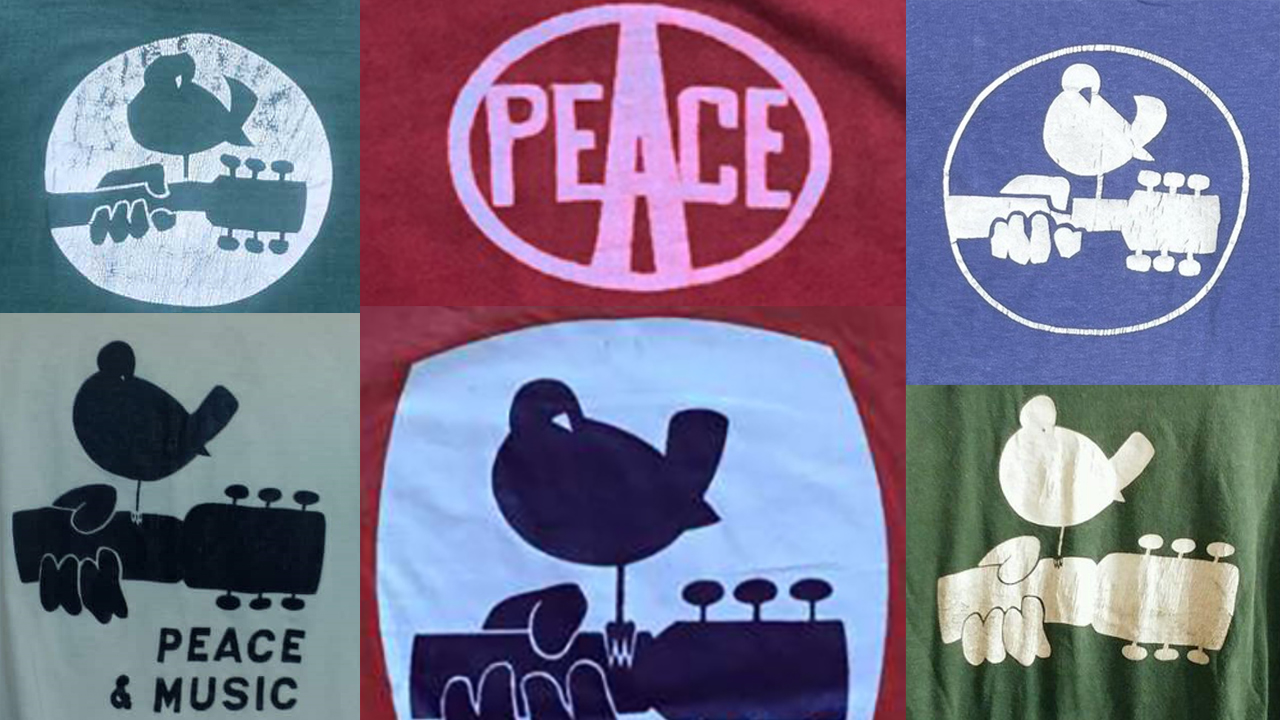
Unofficial Vintage Woodstock T-Shirts
Here’s a small sample of unexplained, unofficial, potentially Woodstock-era event vintage t-shirts. Could one of them have been present at the event? Or were they all post-festival?
Could bootleggers have sold tees at/near the event?
Absolutely — it would’ve been very on-brand for the times. But it remains unconfirmed, and the surviving physical evidence is speculative. Factor in that memories tend to be unreliable after 50+ years.
If any Woodstock shirts were sold by someone working out of a duffel bag or by a roadside vendor, the scale would have been vanishingly small. A single duffel bag could realistically hold 25 to 40 folded T-shirts at most, and even a few such sellers would amount to fewer than a hundred shirts total, lost in a crowd of more than 400,000 people. Roadside vendors faced similar limits, typically arriving by car or van with no tents, racks, or storage infrastructure, and any shirts would have competed with posters, tapestries, or other goods. This kind of ad-hoc commerce simply wasn’t built for volume. So while it’s possible that a handful of unofficial shirts changed hands, the quantities would have been so minimal that their absence from photos, film, and surviving examples is exactly what we’d expect.
Could some of these t-shirts be an afterthought by bootleggers in the days, weeks, months, or years that followed – created and sold across the U.S.?
Yes. In fact, we believe the vast majority are.
Here’s an ad we found in Rolling Stone magazine from November 1969—just three months after the festival. It’s evidence of a post-Woodstock (yet still 1969) bootleg. Without this context, it would be easy to assume it originated at Woodstock.
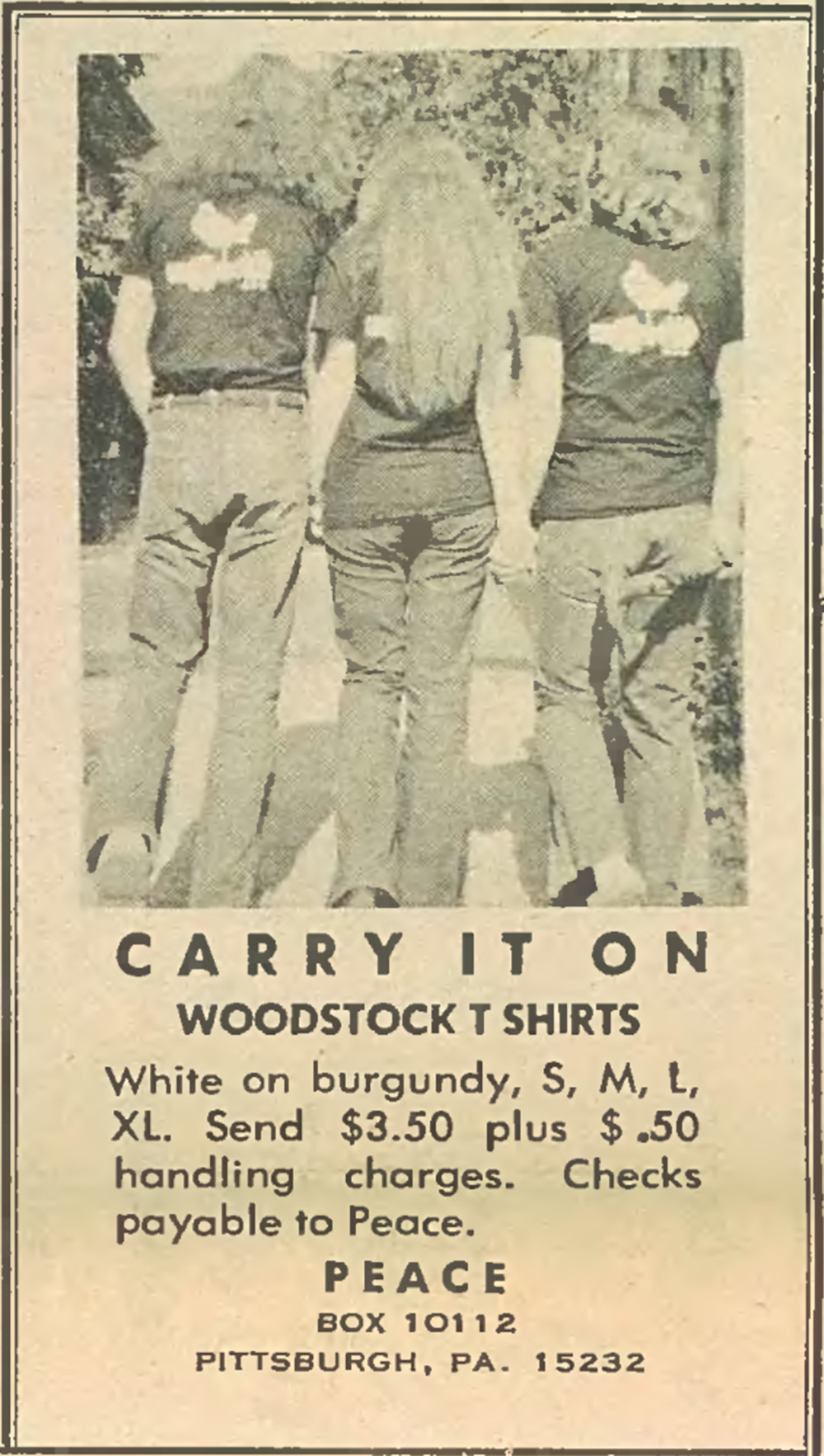
Rolling Stone, November 1, 1969
The Original Woodstock Logo
Given the amount of knock-off logos that were clearly circulating, let’s give credit where credit is due. Arnold Skolnick was the young New York designer whose overnight stroke of inspiration became the face of an entire generation. In the summer of 1969, he was hired—on short notice—to rework the official Woodstock poster after the organizers rejected earlier concepts. With the deadline looming, Skolnick sketched a simple, almost deceptively minimal image: a white dove perched calmly on the neck of a guitar. That clean, peaceful silhouette—paired with bold block lettering—captured the festival’s ethos more effectively than any psychedelic swirl ever could. Skolnick later said, “It was very simple. I saw a bird and a guitar neck, and I put them together.” The design’s clarity and optimism made it instantly iconic, becoming not just the emblem of the festival but a visual shorthand for the entire counterculture era. Decades later, his dove still appears everywhere from posters to T-shirts to museum walls, a timeless reminder of a weekend that reshaped music, art, and American identity.
…BUT Festivals Before Woodstock Had Tees!
What makes Woodstock’s lack of official T-shirts even more striking is that major festivals before it sold shirts. The Atlantic City Pop Festival (1969) — held weeks before Woodstock, featuring many of the same acts — offered branded T-shirts to attendees. In other words, festival merch had already snuck into the culture. Fans were beginning to expect it, promoters were starting to monetize it, and souvenir shirts were already circulating in the rock-tour economy.
This creates the perfect setup for a modern misconception: if the smaller, less mythic pop festivals sold shirts, surely Woodstock — the biggest and most iconic gathering of the era — must have done the same. But it didn’t. And that contrast is what makes the Woodstock staff shirts so fascinating today.
At the Atlantic City Pop Festival, this attendee reported a t-shirt booth. However, he states that it was stocked with “Red Fist of the Revolution” T-shirts, though he didn’t explicitly mention festival tees.
Then there’s this t-shirt.
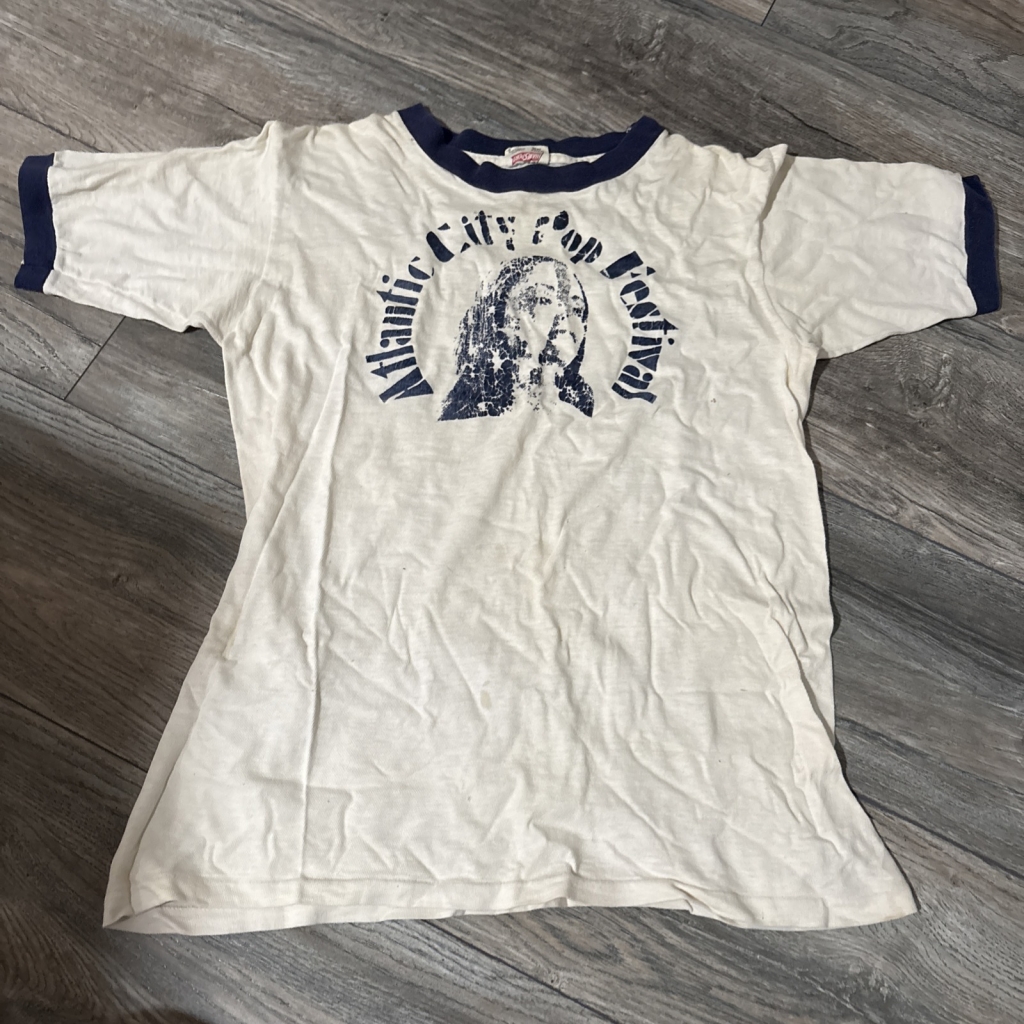
Courtesy: Seth B. / Mary Ann B.
We were in direct contact with the son of the original owner, who confirmed that his mother was not part of the festival staff.
We asked how it was acquired.
“There was a merch booth (‘a table, nothing fancy’), and that’s where she bought the shirt; she couldn’t remember any other details,” Seth B. told us.
Further, a primary-source newspaper preview of the July 1969 Atlanta Pop Festival makes it clear that vending was not an afterthought — it was baked into the business model. The organizers planned “record sales booths, posters, hippie paraphernalia, mod clothes and a carnival,” plus rows of rented booths in what the paper described as a “flea-circus arrangement.” That infrastructure all but guaranteed the sale of T-shirts and other wearable souvenirs, and a firsthand account from the owner of an original Atlanta Pop tee confirms that shirts were indeed purchased on-site. This matters because it shows that by the summer of 1969, festivals before Woodstock were already embracing a thriving merch economy. It makes perfect sense that people assume Woodstock sold shirts — most of the major festivals around it did. Woodstock’s total absence of public merch is the exception, not the rule.
The cool part about the newspaper article we cited? It was provided to us by the owner of the t-shirt shown above, who photographed it directly from her scrapbook of memories.
This level of confirmation has remained elusive among owners of Woodstock tees purportedly from the event, with only one claim warranting closer examination later in this piece.
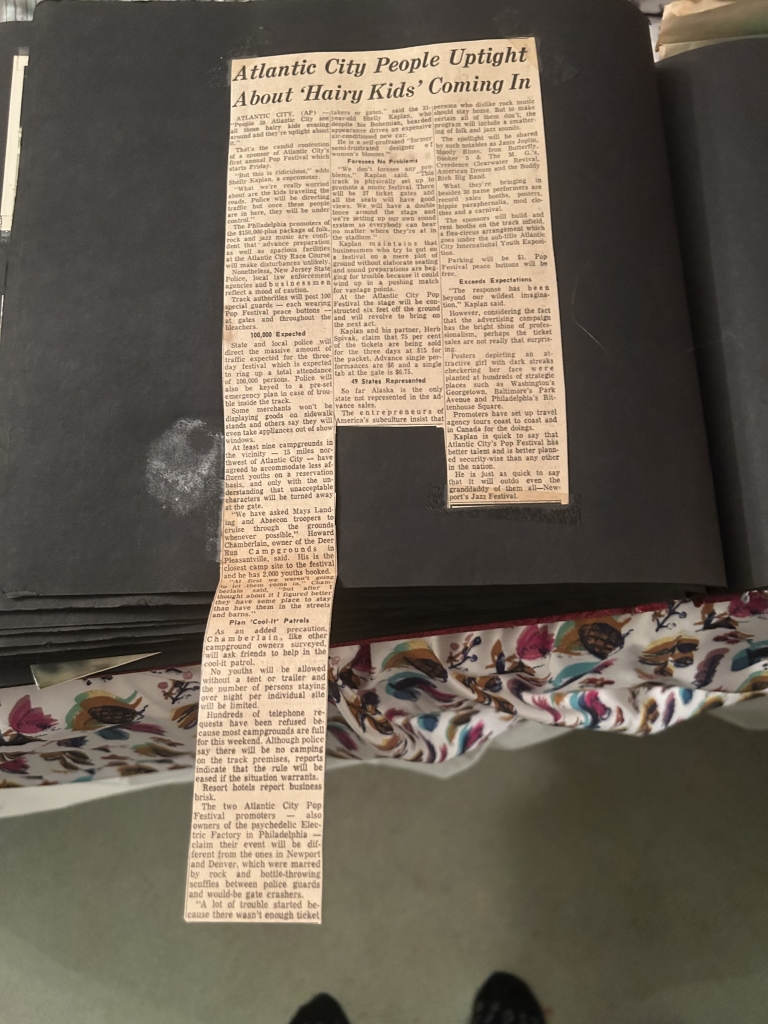
Courtesy: Seth B. / Mary Ann B.
Finally, another version of this shirt, this one “signed” by several of the performers.
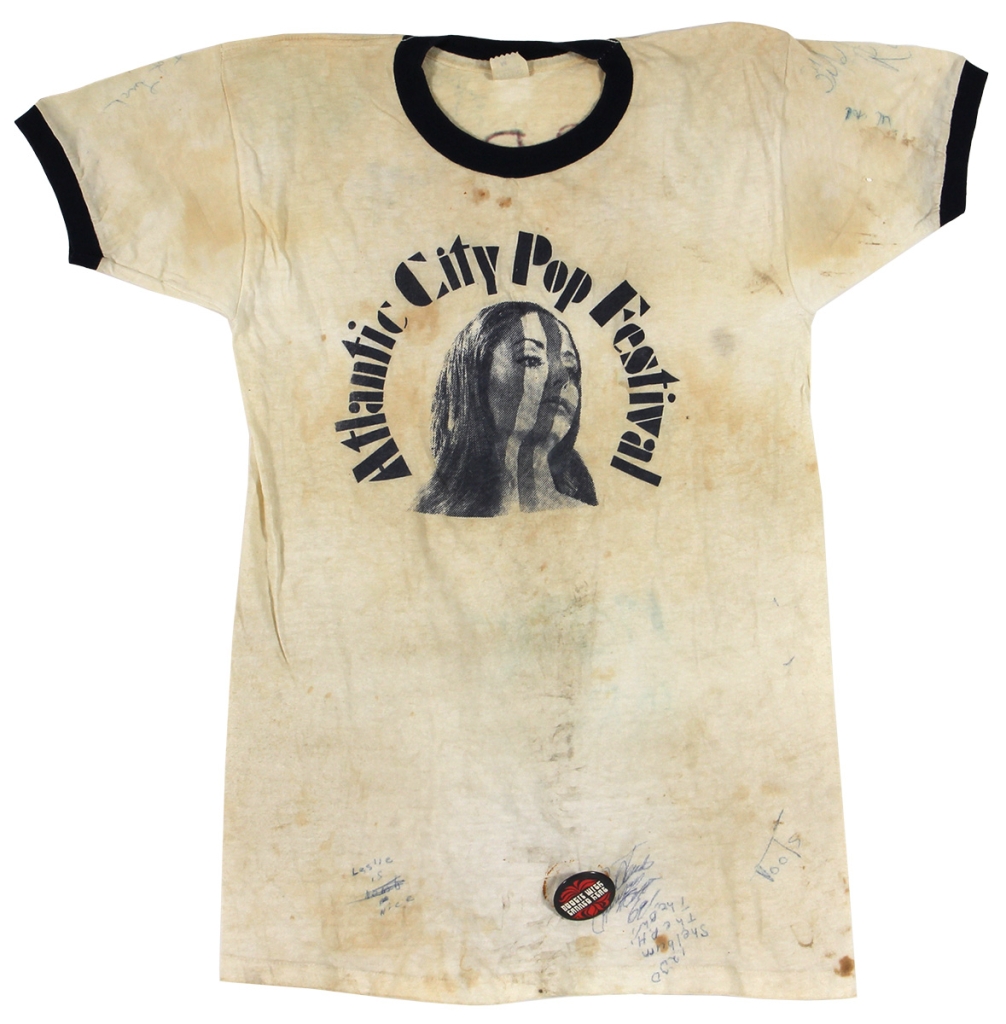
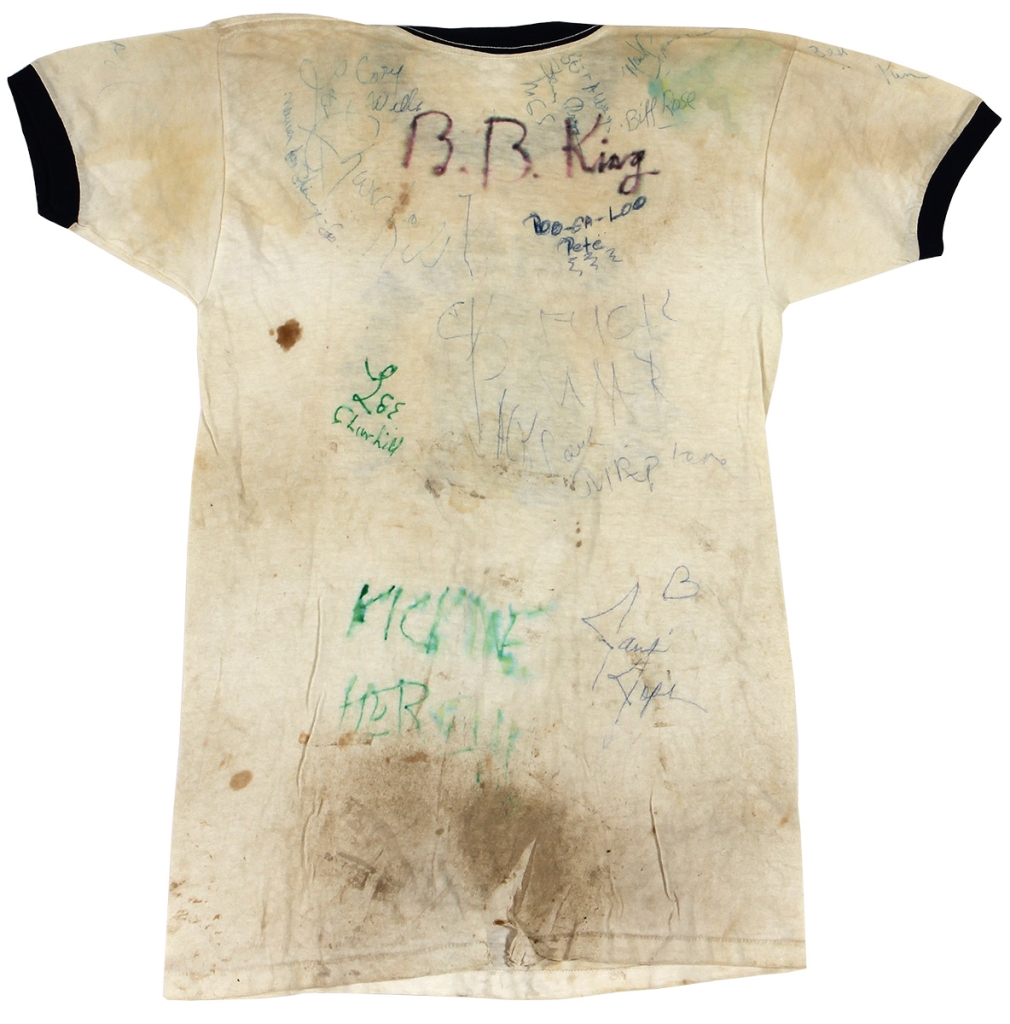
Courtesy: gottahaverockandroll.com
Full disclosure: In recent years, we’ve observed multiple instances of auction houses providing incorrect key details in their vintage t-shirt offerings, such as the Red “Security” Woodstock we discuss later in this article. As a result, we tend to take most of their claims with a grain of salt. A quick comparison with B.B. King’s known signature raises some eyebrows. We’re not autograph experts, certainly, an autograph can’t be written as smoothly on a piece of cotton, but it seems to be completely different.
That said, the auction details indicate that the shirt’s owner claims to have purchased it at the event.
This is an original t-shirt that was sold at the 1969 Atlantic City Pop Festival concert…This shirt comes from the person who was at the show, bought the shirt while she was there…
In 1970 and the years that followed, t-shirt booths were a fixture at these festivals. What’s striking is that, in this same moment when T-shirts were becoming standard at big concerts, Woodstock itself offered no official merch to the public at all.
Case in point: and this is where it gets a little weird. According to the gentleman who has this Woodstock t-shirt framed and on the wall of his office, he purchased it at the second Atlanta Pop Festival.
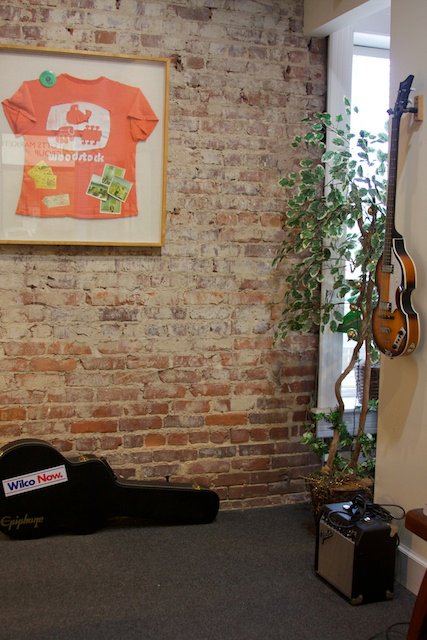
Facebook/Potts Marketing Group, LLC
“I bought that shirt at the second annual Atlanta Pop Festival, 4th of July weekend in the summer of ’70. The vendor said they were left over from the Woodstock festival the previous summer, but having seen shirts in the movie and in other Woodstock documentary photos, this was more likely a first version knock-off.” – Tom Potts
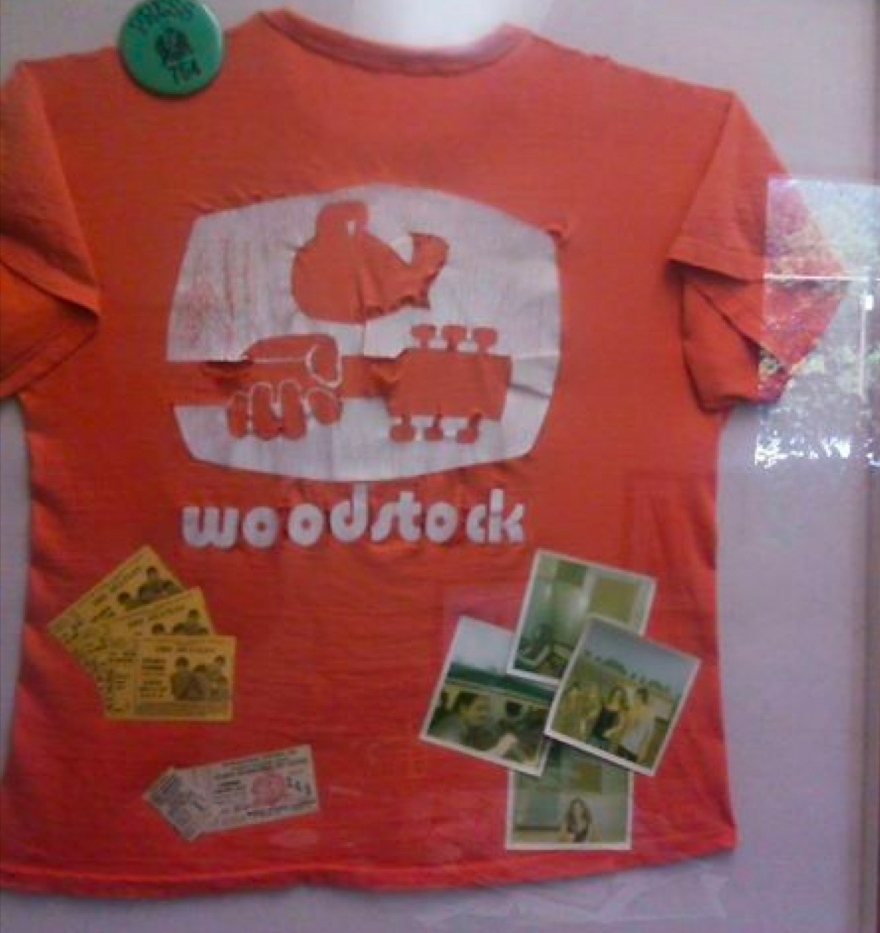
Courtesy Tom Potts
Notably, the original staff t-shirts did not have “Woodstock” on them, so Tom’s clarification aligns with what we know about the staff t-shirts, despite the crafty seller’s claim. We have to admit, Woodstock-overstock is a compelling sales pitch.
Maybe there’s some truth to it? According to an eBay listing from 2024, for a match of the t-shirt featured above, another anecdotal claim is made:
“This t shirt was actually there unlike a lot of the other ones for sale everywhere look at the tag in this shirt it still has its tag unlike most other one don’t my aunt bought this when she was walking in too the event from a vender selling out of a big duffel bag he was selling a little bit of everything she said lol she was there for two days and said she wore the shirt half the time she was there and the rest of the time I guess she had nothing on! She said she paid 7 dollars for two shirts for her and her friend. would be awesome displayed at a bar or in a movie room or man cave.”
(BTW, one of these tees made a cameo at a Led Zeppelin concert in Fort Worth, Texas, in 1970.)
What’s most interesting is that other festivals were already monetizing festival merchandise before Woodstock, and fifty years on, memories—shaped by time, overlapping experiences, and sometimes altered states—can naturally become conflated.
The Only Official Woodstock T-Shirts: Made for Staff
There is one category of Woodstock T-shirt with rock-solid provenance: the staff shirts.
Printed shortly before the festival, these shirts were never meant for sale. Instead, they served a functional purpose — identifying crew members in a swirling, chaotic mass of humanity.
Those who wore the shirts, and modern collectors generally agree on the following colors and roles:
Red
Most often attributed to event Security and also worn by Medical staff.
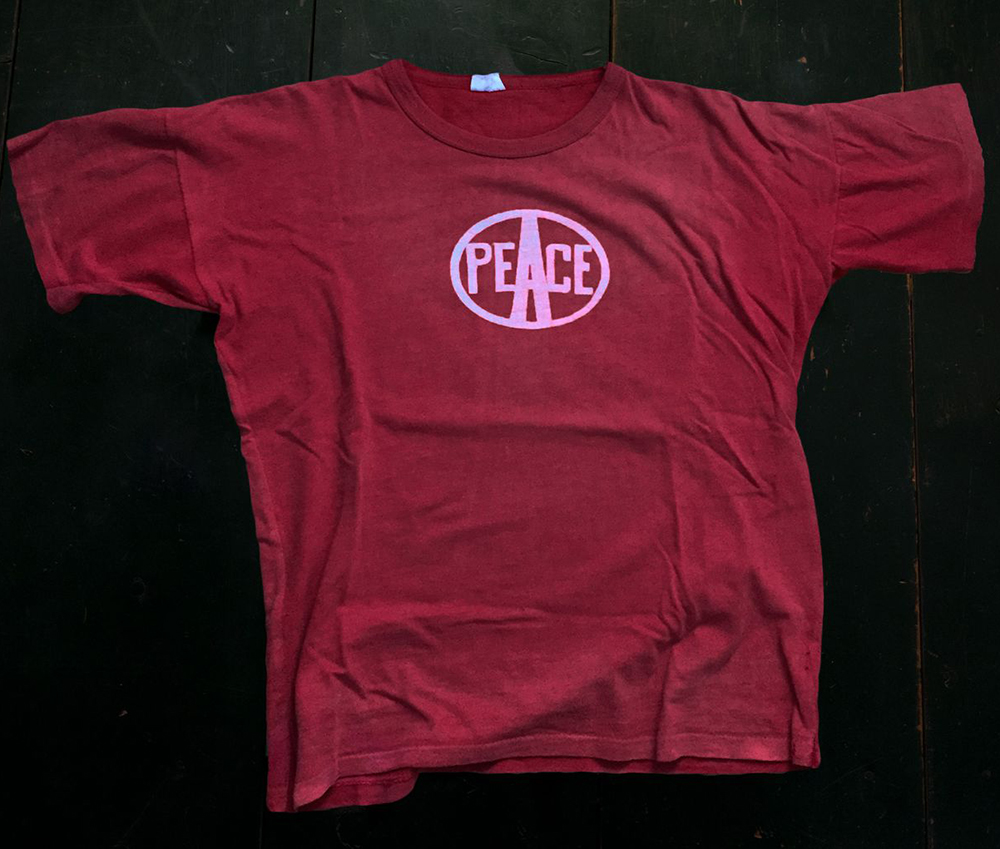
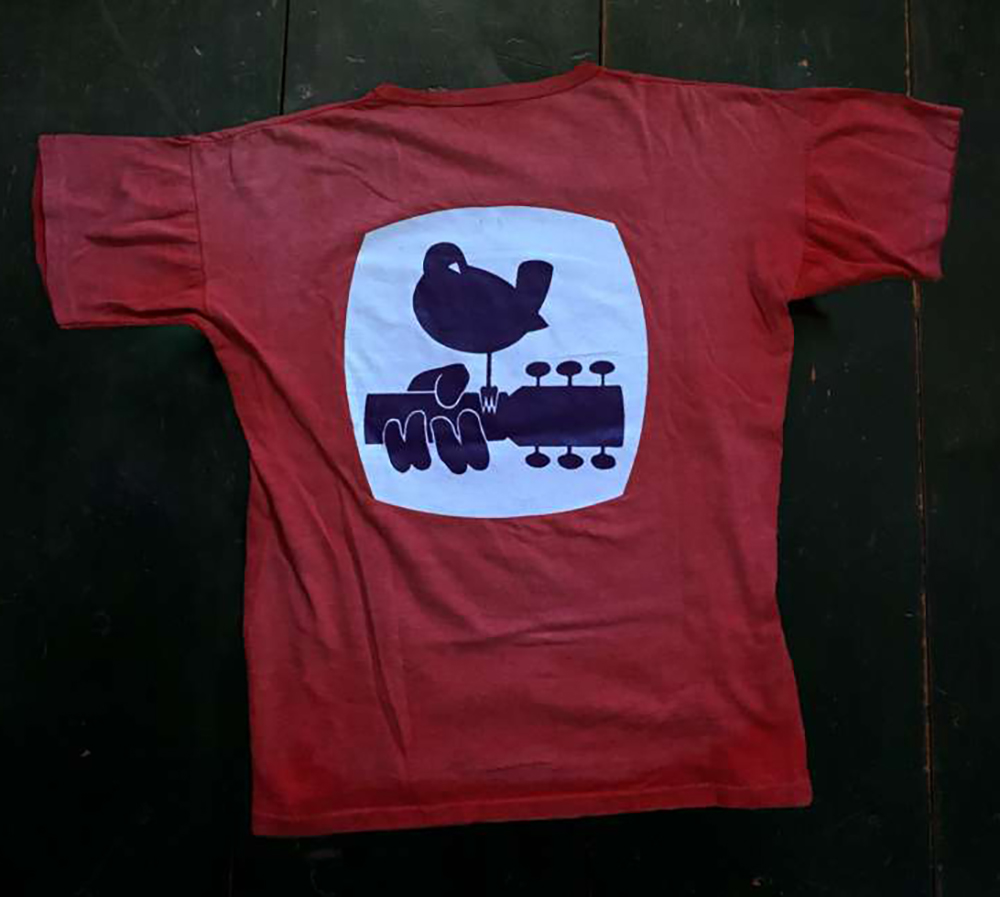
Courtesy Max Bittle: IG/MaxSnaps
The surviving worn ones are often faded and sometimes appear orange.
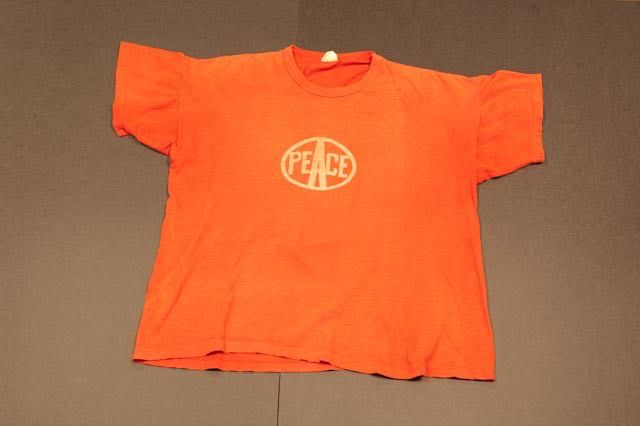
Courtesy Max Bittle: IG/MaxSnaps
Here’s a photo of someone wearing a red shirt joining forces with a green-shirted individual to rotate the stage. And then there’s this photo of an unidentified man in a red tee, enjoying a cold one by the river, and these two staff members taking a break among the crowd.
To further confuse matters, well-known auction houses have also contributed to the red t-shirt myths.
A description from an auction hosted by Heritage makes numerous inaccurate claims about this Woodstock t-shirt:
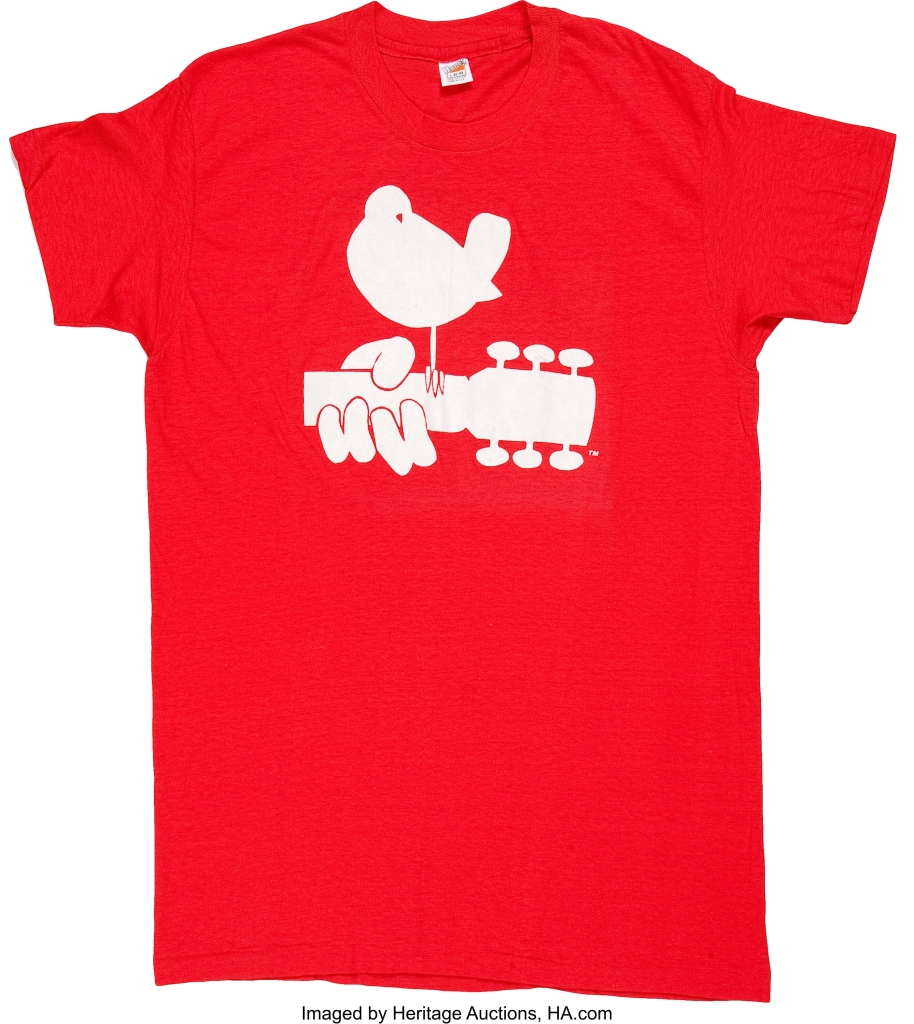
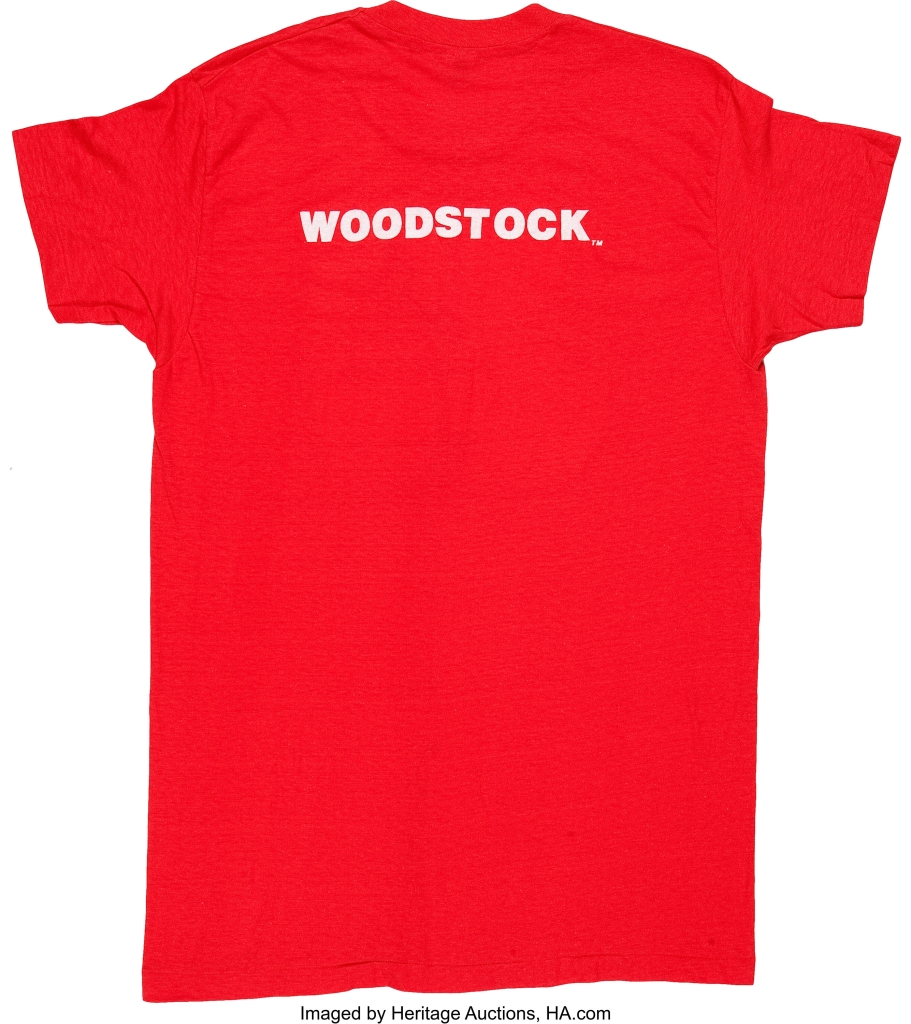
“Woodstock Security Staff T Shirt and Original Handbill (1969). John Roberts and Joel Rosenman, the original financiers of the 1969 Woodstock festival, had approximately 350 security staff red t shirts printed with the white Dove and Guitar logo silkscreened on the front, and the name “Woodstock” printed on the back. These red shirts were different from those worn by construction workers, stage hands, and vendors, with very few surviving past the three-day extravaganza. Here’s a Excellent condition t shirt (size: Large) from that original batch, obtained from an acquaintance of John Roberts.”
Given the fact that the Hanes tag attached to this t-shirt didn’t exist in 1969, something is clearly amiss.
Since there’s no official record of production quantities, this acquaintance may have been repeating something an organizer told them. However, the shirt in question clearly doesn’t match the documented staff tees seen in 1969 photos and footage. That discrepancy makes it impossible to believe any part of their claim. The presence of a trademark symbol—absent on all known original staff shirts—further indicates that these were produced years later, not for the festival.
Heritage’s catalogue description makes multiple assertions that aren’t supported by physical evidence or period documentation, such as specific production numbers and organizational involvement. The Hanes tag, which didn’t exist in 1969, clearly indicates that the shirt is a later reproduction.
Blue
Stage Crew.
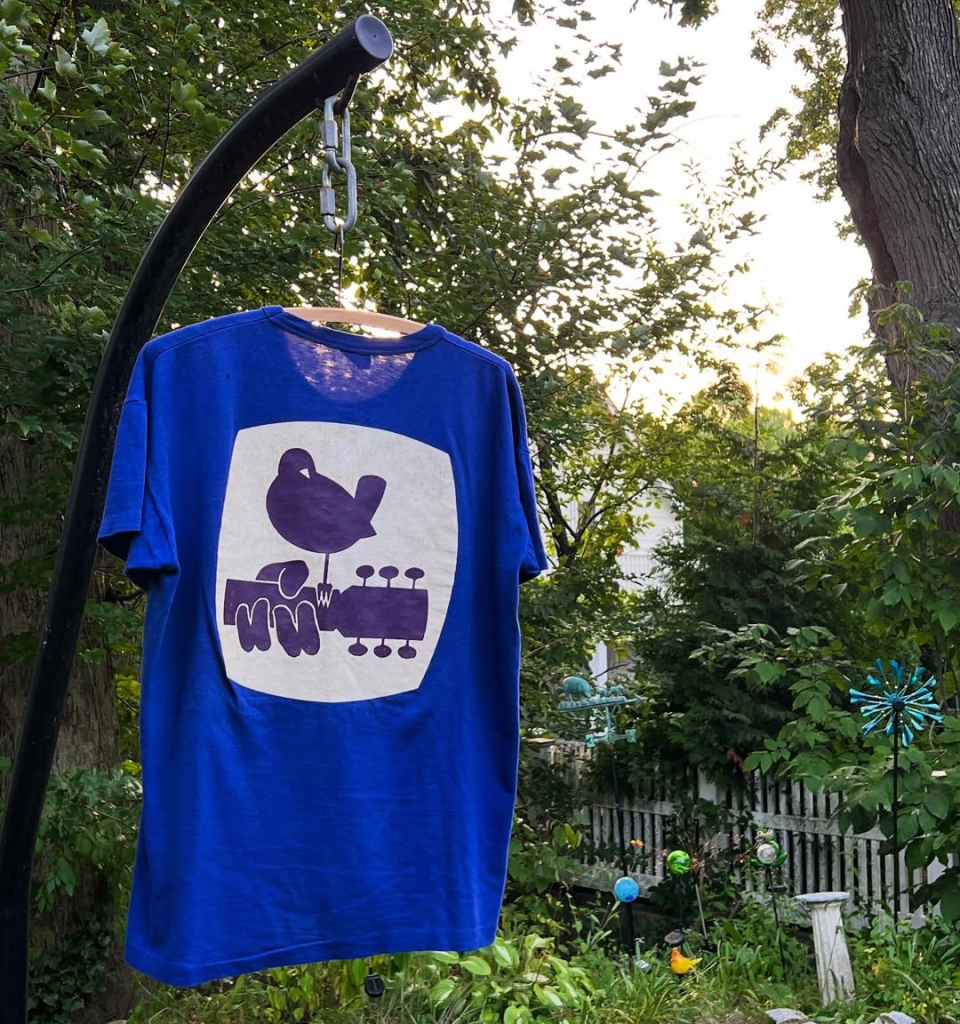
Courtesy: IG/StephenVoland
Blue doesn’t appear in photographs as much, suggesting it might have been produced in smaller quantities than red and green, but here’s one in action.
Green
General Staff.
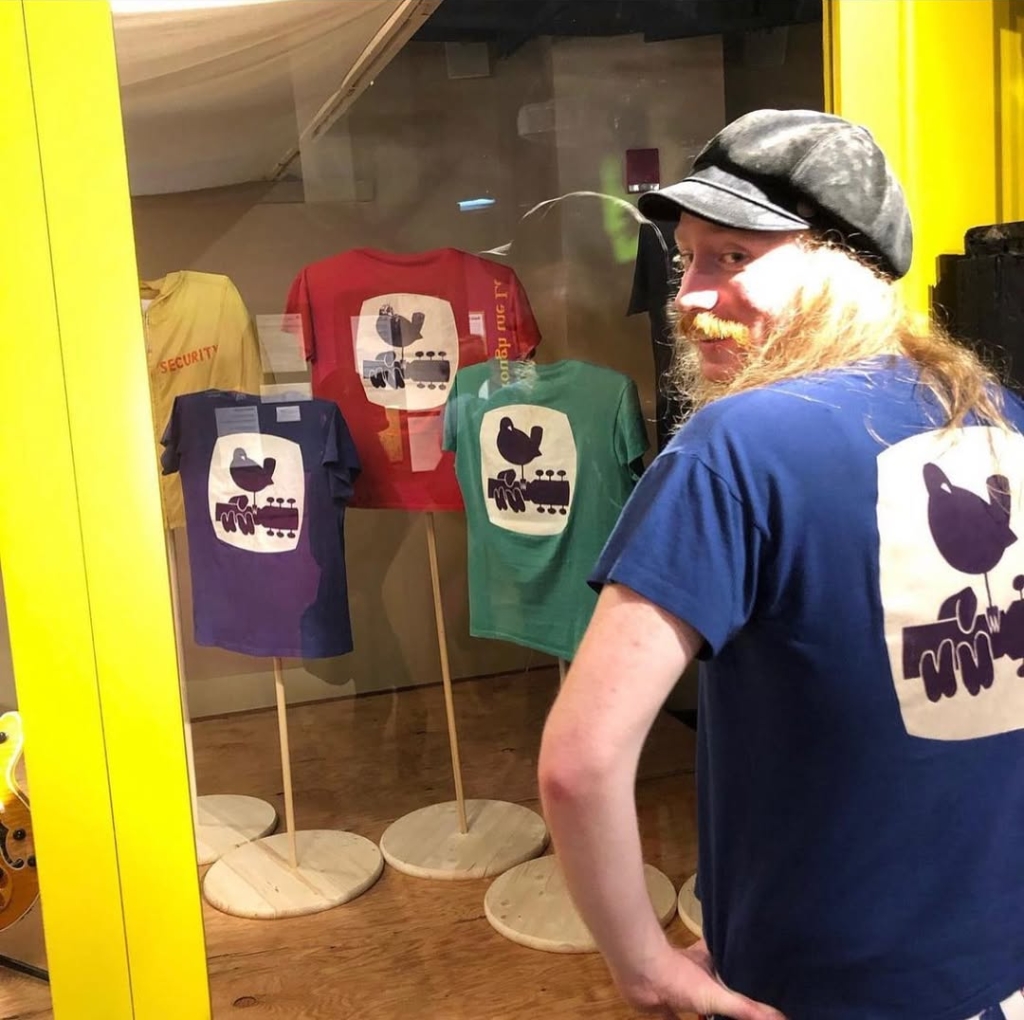
Courtesy: IG/StephenVoland
We found this photograph depicting a gathering of green-shirt wearers and of a solo, sleeveless staff member. There were many children at the festival, one of whom is photographed wearing a green shirt.
Black
Organizers. Managers. VIPs. Stagehands? Undercover cops?!
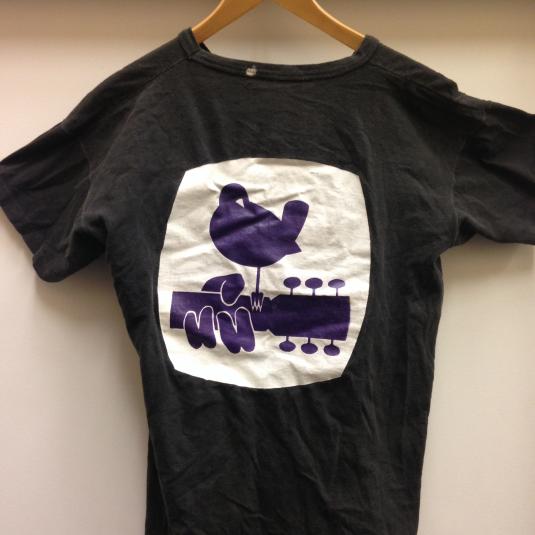
defunkd/niamiah2
Among Woodstock collectors, there’s a mystery with the black staff t-shirts. For decades, rumors have swirled that the black shirts marked undercover NYPD officers or VIPs. The best evidence we have, though, comes from Wade Lawrence, director of the Museum at Bethel Woods.
Max Bittle, with whom I collaborated to write this post, is a vintage rock t-shirt aficionado (and a stellar photographer, too!) Max contacted Wade years ago to inquire about Woodstock tees.
“Security got red t-shirts (along with a red windbreaker), and festival organizers and head honchos got black.”
According to Lawrence, black appears to have signaled top-tier Woodstock staff rather than secret cops. So far, no museum, organizer, or contemporary account has backed up the undercover-NYPD story, which seems to live more in Woodstock mythology than in the historical record.
(While there may be no truth to the claim that undercover cops wore black t-shirts, based on one account, there were off-duty NYC police in attendance. One of whom owned a red security t-shirt.
“The shirt was given to me in 1970 or 71 by my next-door neighbor and tenant of my parents. His name was NYC Transit Police Officer Louis (Sonny) Segreto. Contrary to some reports claiming no off-duty police officers were allowed to moonlight at the event, he and others did indeed do so.” – David D.)
There’s a photo of a black tee draped over an unidentified individual at the front of the stage, taken while Country Joe and The Fish were performing. Whomever it is doesn’t appear to be part of the band. In another shot featuring Joe Cocker, another unidentified man wears a black one backstage.
And given the information provided by the individual who posted this black Woodstock t-shirt on our marketplace 10 years ago:
“Original Woodstock t-shirt from my FIL – he was hired as a carpenter when they were building the set, and later as a stage hand. I have the ‘Bullshit’ pass somewhere as well, but it’s unrecognizable.”
Among the destinations for black tees could be stagehands, given that they were working with the performers; it would make sense that they would be assigned high-level access.
Further information about black Woodstock T-shirts comes from Jodi Salisburg, daughter of Leonard Kaufman (aka Lenny), who shared a photo of her father’s Woodstock shirt and accompanying pins.
“He was head of security and was in the helicopter that flew the bands in. He was an organizer and a close friend of Michael Lang. We lived in Woodstock and then moved to a farmhouse in Saugerties, which we called a motel because many hippies stayed there. He was also the founder of a recording studio called Karmic Guardians – Looking Glass mixed tracks there,” Jodi told us.
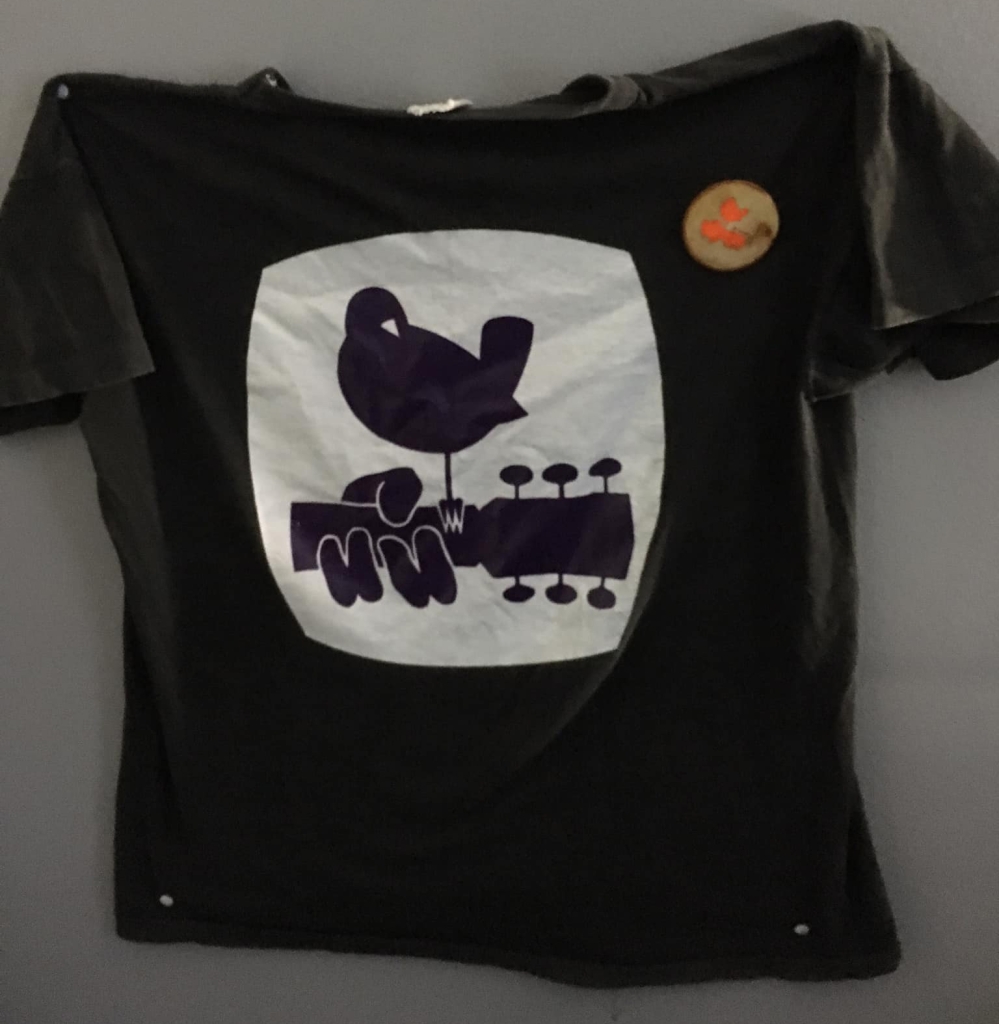
Courtesy Jodi Salisburg
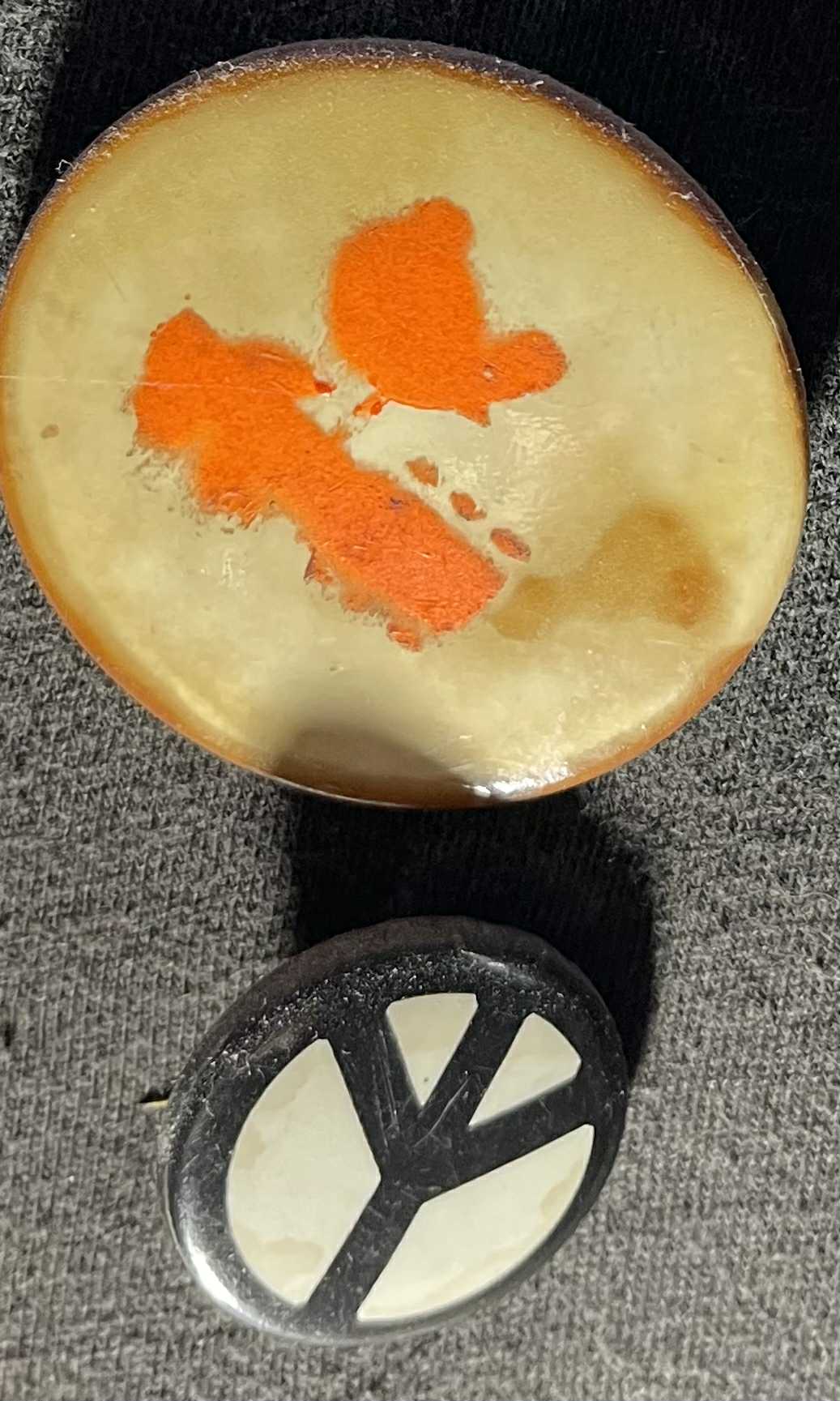
Courtesy Jodi Salisburg
How Many Woodstock Staff T-Shirts Were Printed?
While no official production records survive, a realistic estimate suggests between 300 and 500 staff T-shirts were printed for Woodstock. With several thousand people working the festival, but not all needing visible identification, staff apparel would have been limited by design.
Green shirts—seen most frequently in the documentary—likely made up the majority, followed by smaller runs of red (security), blue (stage crew), and a minimal number of black shirts reserved for senior staff. Even at the high end, that number represents a tiny fraction of the 400,000-plus people in attendance, helping explain both their rarity today and the fact they they only appear in a fraction of the photos or footage.
Felco T-Shirts
If you have a legit, event-issued Woodstock staff t-shirt with a tag still attached, it looks like this:
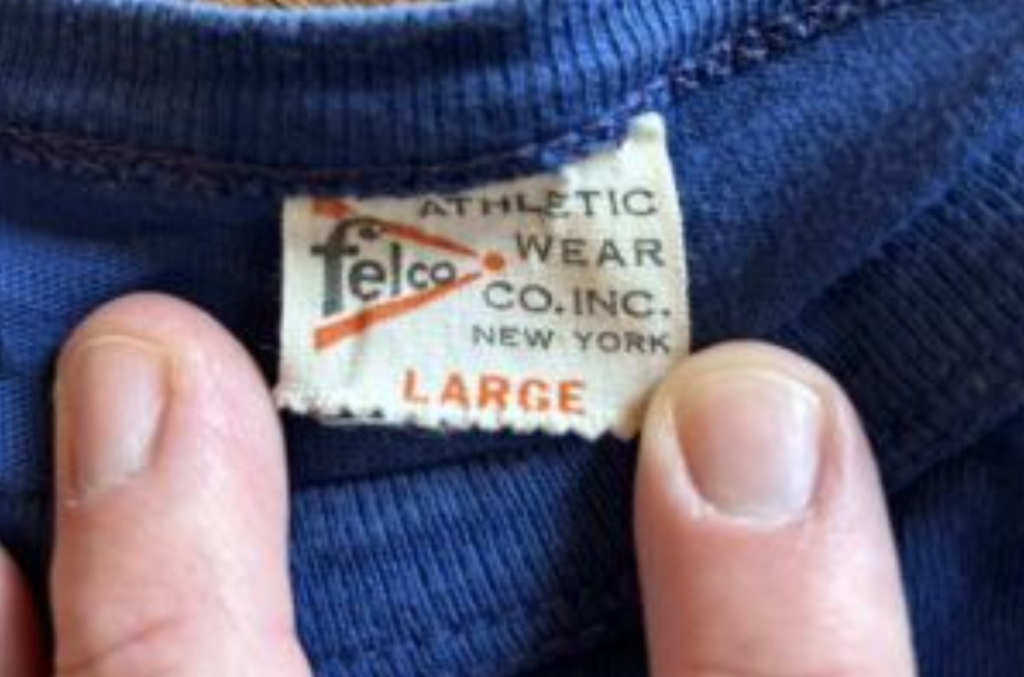
WorthPoint
Felco’s connection to Woodstock makes practical sense. The company was a New York–based athletic-wear manufacturer that produced sturdy cotton blanks favored by schools, sports teams, and work crews throughout the region in the 1960s.
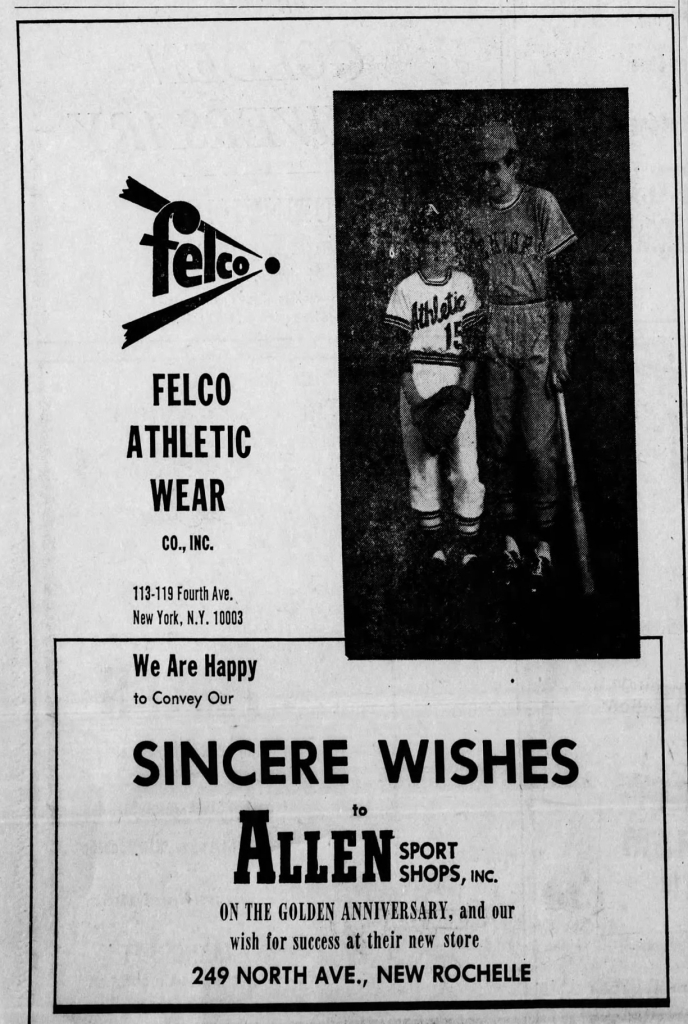
The Standard Star, New Rochelle, NY, March 19, 1973
Since Woodstock Ventures was also headquartered in New York—and scrambling in the weeks before the festival to source everything—Felco would have been a natural supplier. Their shirts were readily available and close enough for rushed orders. While no surviving invoices confirm Felco’s connection to Woodstock, the geography and timing align perfectly: if the organizers needed a few hundred shirts printed fast for staff, stagehands, or security, a New York athletic-wear manufacturer like Felco would have been exactly where they turned.
Almost all Woodstock staff tees, with a tag still visible, are Felco-branded.
The Green T-Shirt Tag Variant
There is one exception to the Felco tagged t-shirt, and according to Max Bittle, the other tag has only been found on the Green tees.
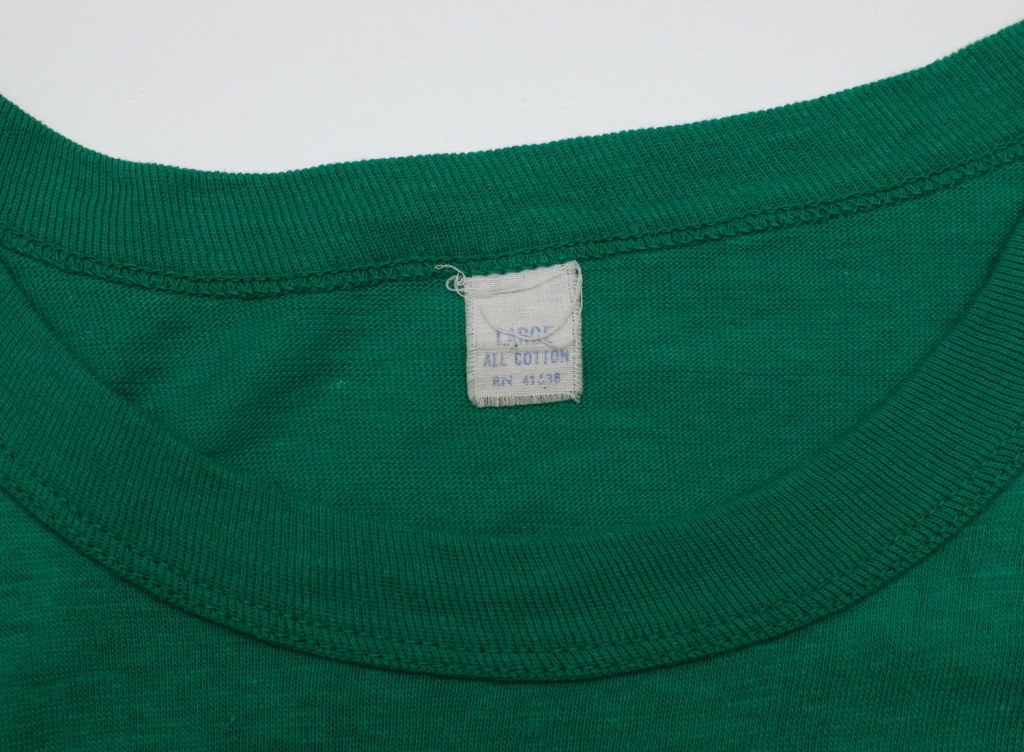
Courtesy: Max Bittle
The generic RN 41638 tag traces, in the FTC database, to a Pennsylvania company called Jakro Inc. There’s nothing in the festival’s histories that mentions a direct Pennsylvania connection. Still, it’s an intriguing data point. The festival was staged in upstate New York, and the whole operation relied on the broader NY–NJ–PA supply chain. At minimum, the RN lookup shows that not all Woodstock staff shirts came from the same New York blank provider—and proves that a significant number were sourced from a small Pennsylvania manufacturer.
One could hypothesize that at some point, the promoters needed additional green tees, which is plausible given they were “general help” and likely found their way onto more torsos than the other color classifications.
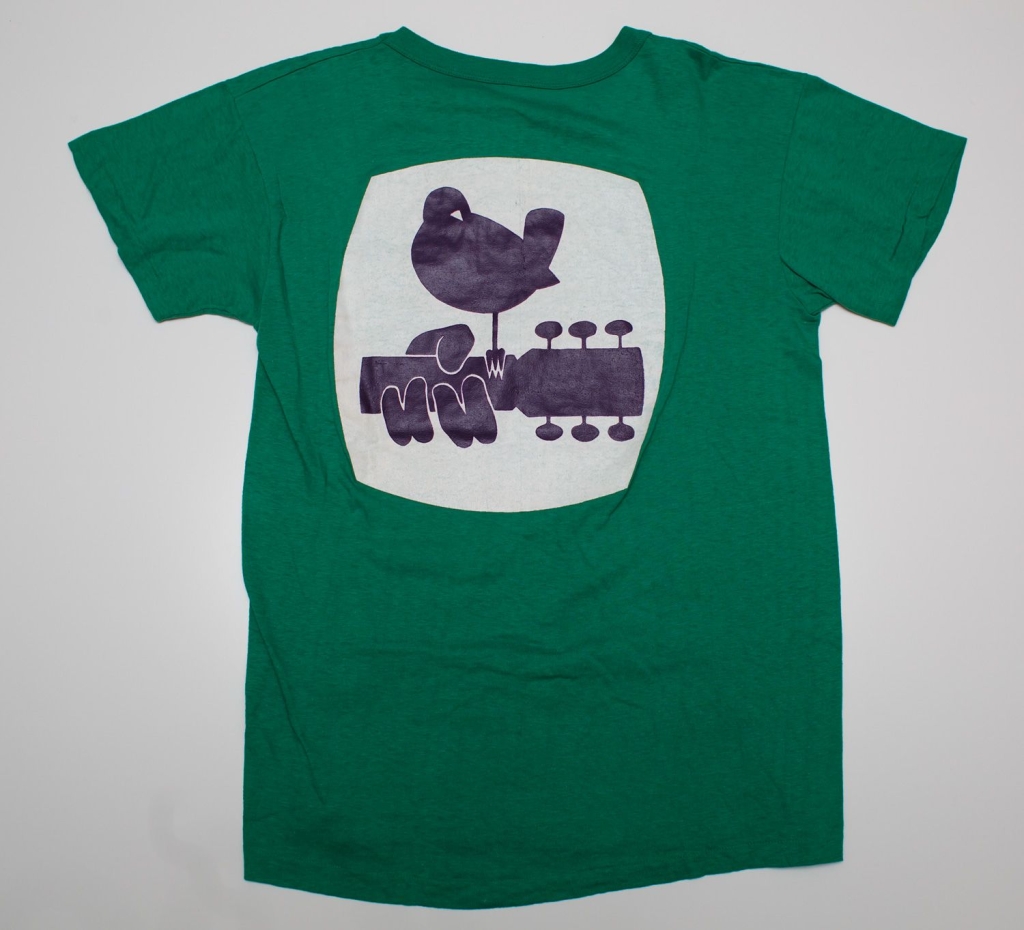
Courtesy: Max Bittle
Max and I each own a green t-shirt with this tag, and they appear to be a darker green than their Felco counterpart. Interestingly, both came from Fillmore East employees. There may be a Fillmore East connection to this variant, given that their staff intervened to assist amid the understaffed chaos at Woodstock.
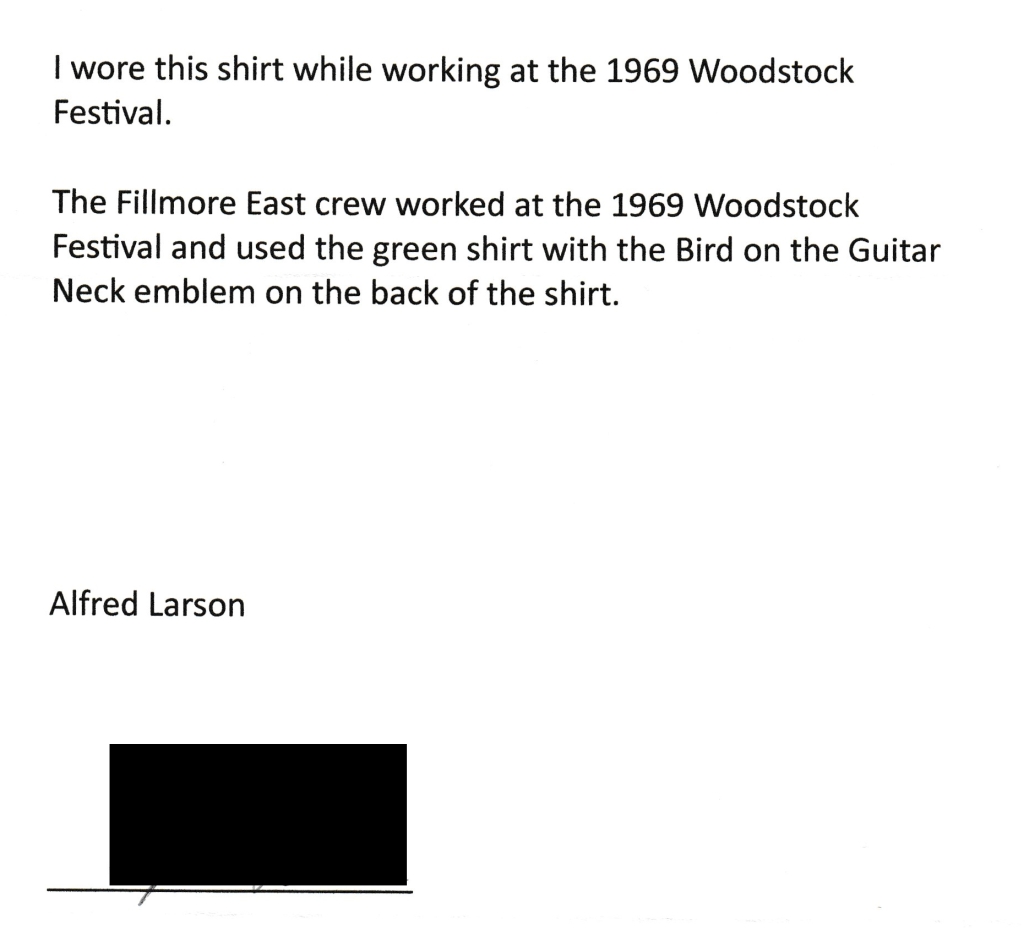
Courtesy: Max Bittle
The Unsung Workforce Behind Woodstock
One of the least-discussed truths about Woodstock—yet one of the most thoroughly documented in Bill Graham Presents: My Life Inside Rock and Out—is just how the festival depended on the expertise of the Fillmore East staff. While the public myth frames Woodstock as an effortless cosmic convergence, the people who actually built and stabilized the event tell a very different story.
According to Bill Graham and the members of his team, quoted throughout the book, Woodstock functioned because seasoned Fillmore personnel were brought in at the last possible moment to prevent the festival from imploding.
Kip Cohen, then general manager of the Fillmore East, is explicit in the book about how Woodstock’s organizers relied on Fillmore talent:
“Woodstock capitalized on the smarts that our staff had created for themselves in running the Fillmore. John Morris, Chip Monck, and Chris Langhart were the nucleus of people who staged the festival.”
This wasn’t a casual consultation—it was the transfer of the Fillmore’s operational expertise. Monck and Langhart were legendary for their technical discipline, stagecraft, and ability to keep a venue running under extraordinary pressure. Bringing them to Woodstock meant importing the only team on the East Coast that truly understood how to run a large-scale, multi-act production with a high level of professionalism.
But the real emergency came just days before the festival. As documented in Graham’s book, the local sheriff’s department walked off the job, leaving Woodstock Ventures without functioning security or crowd control. In Bill Graham Presents, Fillmore stage manager Jerry Pompili recounts what happened next:
“So guess who was left doing the security for Woodstock? Sixty-four people from the Fillmore East, who for three fucking days didn’t sleep… lived in fucking mud.”
These weren’t volunteers—they were the same hardened professionals who handled the nightly chaos at the Fillmore. Suddenly, they were in a field in upstate New York trying to hold together a crowd of hundreds of thousands.
Bill Graham himself clarifies in the book that the Fillmore crew wasn’t “taken” by Woodstock—they were offered:
“In terms of the Fillmore East staff, they didn’t take them. I gave them to them.”
In other words, the festival’s success was due in no small part to Fillmore veterans.
This revelation from Bill Graham Presents has a major implication for anyone studying Woodstock’s staff apparel. Many individuals photographed wearing the staff shirts were not local hires, but were Fillmore East personnel deployed as emergency security and production crew.
This helps to explain the variation in shirt blanks (Felco, RN41638) and the uneven color distribution.
Woodstock may have had a pre-planned color protocol for staff, but the last-minute, patched-together workforce could mean more of a free-for-all than most believe.
What Did People Wear at Woodstock?
After tracking down every archival photo we could find via the web, a few things become clear:
Many festivalgoers wore striped t-shirts.
More attendees wore plain t-shirts, mostly white.
Many wore button-downs (flannel, denim, or military surplus).
Some wore ponchos, jackets, or blankets because of the rain and mud.
Many were bare-chested, including the ladies.
Hey, some event goers were also completely naked, walking among the crowd or skinnydipping in local rivers.
But we could not identify a single attendee wearing a bootleg Woodstock-logo tee.
In fact, there are only a few instances in which a graphic tee is visible among attendees in any of the photos. The T-shirts were overwhelmingly blank, a sign of the times.
Mickey Mouse makes an appearance on the torso of Doug Clifford of Creedence Clearwater Revival. According to internet lore, Doug’s appearance in the Woodstock film was edited out because Disney wouldn’t give the filmmakers permission. Classic Disney.
As far as rock tees go, there’s only one that we’ve seen make a cameo at Woodstock, none other than John & Yoko’s two virgins t-shirt.
Clearly visible on festival attendees, here and here.
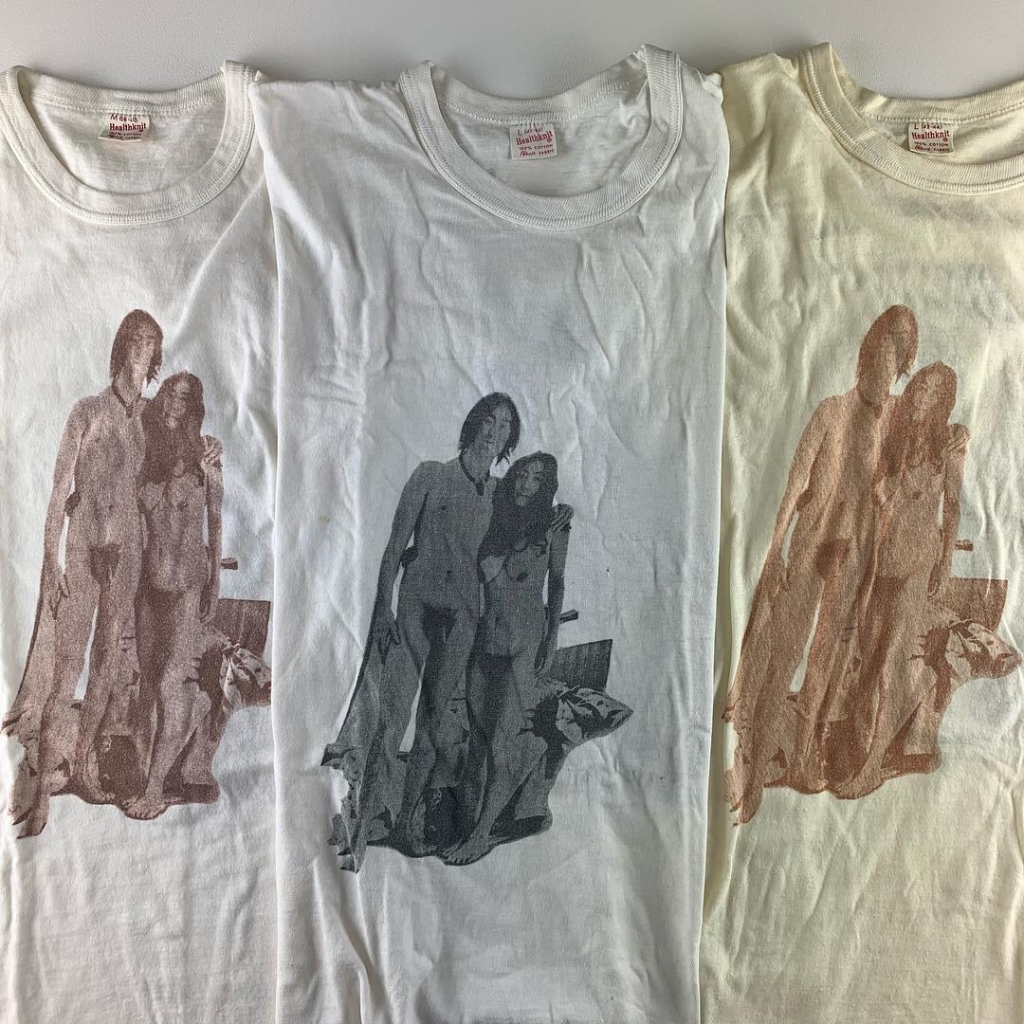
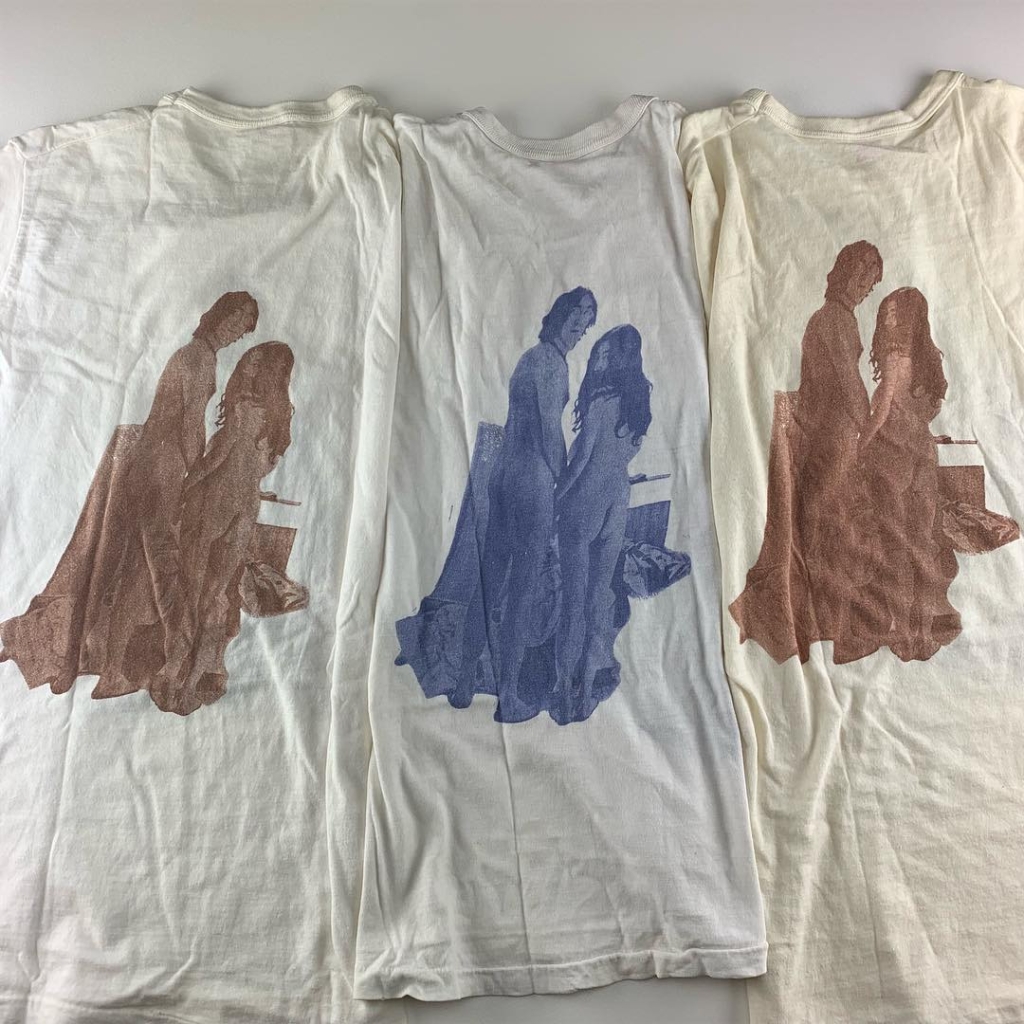
Courtesy: Patrick IG/WycoVintage
What the 1970 Woodstock Documentary Reveals
A close study of the 1970 Woodstock documentary provides several important new details that couldn’t be gleaned from the photos we reviewed. Across more than three hours of footage, green staff shirts appear far more frequently than any other color, with only occasional glimpses of red or blue, suggesting that green may have been the most widely issued crew shirt. Several shots show workers wearing their shirts backward, displaying the dove logo on the chest — a detail that helps explain why some have suggested that front-printed Woodstock shirts existed.
Among attendees, the film corroborates the photos: graphic T-shirts were surprisingly rare; most people wore plain white tees, striped shirts, or simple lettered tops.
More striking is the recurring presence of black Woodstock jackets, one of which Jerry Garcia wears in a cameo early in the film. They are also worn by the staff who greeted artists arriving by helicopter, strongly supporting the idea that black garments signified VIPs or high-level production crew. Country Joe McDonald even performed in one.
Does the documentary reveal any other Dove and Guitar T-shirts worn by attendees? We never observed the logo on any non-staff shirt – but as we’ll reveal later in this piece, we were looking for the wrong imagery.
Woodstock Documentary (& Album?) Promotional T-Shirts
Michael Wadleigh’s 1970 documentary and its subsequent theatrical release. Then, a few months later, the Woodstock album hit the shelves. These—not the festival itself—are what truly cemented Woodstock in the cultural imagination.
These are sometimes mistaken (or purposely mislabelled) as 1969 Woodstock event originals, but their timelines are firmly in the documentary era, post-festival.
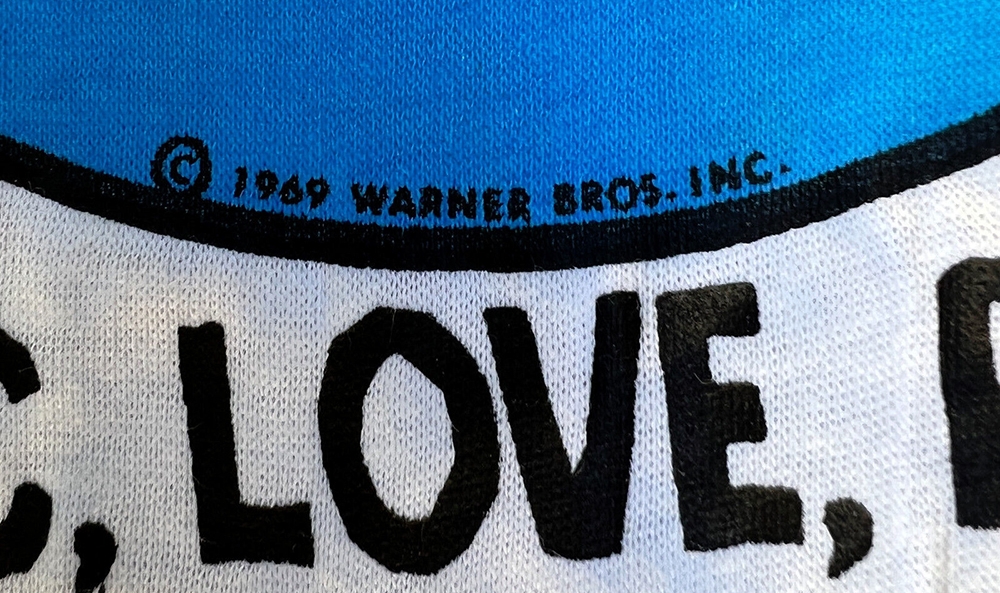
We conducted a targeted search for official documentation linking Warner Bros. to Woodstock T-shirts, reviewing studio press materials, theatrical pressbooks, trade coverage, and record-label promotional ephemera associated with both the 1970 documentary and the soundtrack album. While no pressbooks or studio materials explicitly list T-shirts as part of either campaign, surviving examples bearing the ©1969 Warner Bros. credit suggest that officially authorized shirts did exist in the post-festival period.
The copywriten designs differ—one featuring a bold front-printed logo and slogan, the other a simpler centered mark—leaving open several possibilities: that both were tied to the film’s release, that one was produced to promote the documentary while the other supported the album, or that they represent separate licensed runs issued at different moments as the Woodstock brand, the movie, the album entered wider circulation.
What remains clear is that these shirts date to the era after Woodstock, not to the festival itself, and that their exact promotional purpose has not yet been confirmed.
These two T-shirts mirror the imagery present on authentic Woodstock movie promotional posters. The first one has a © symbol to the lower right of the design.
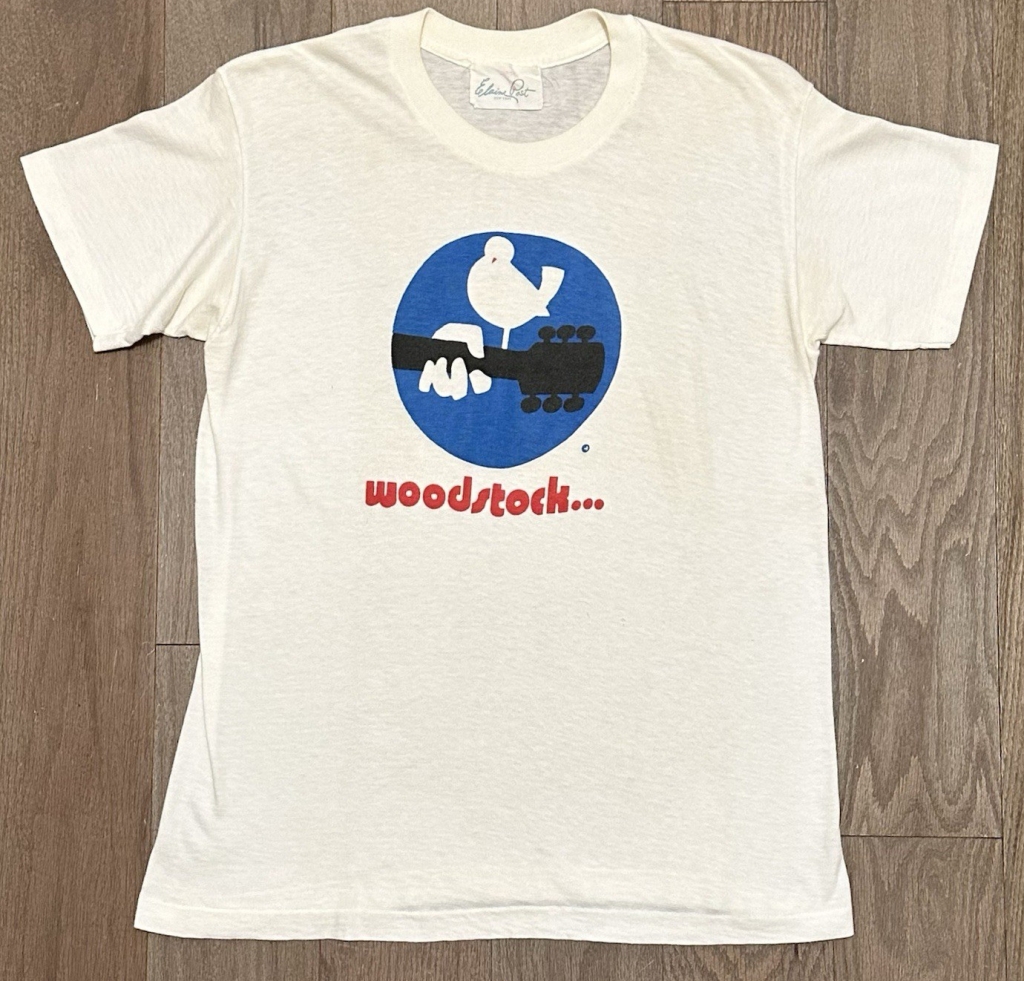
WorthPoint
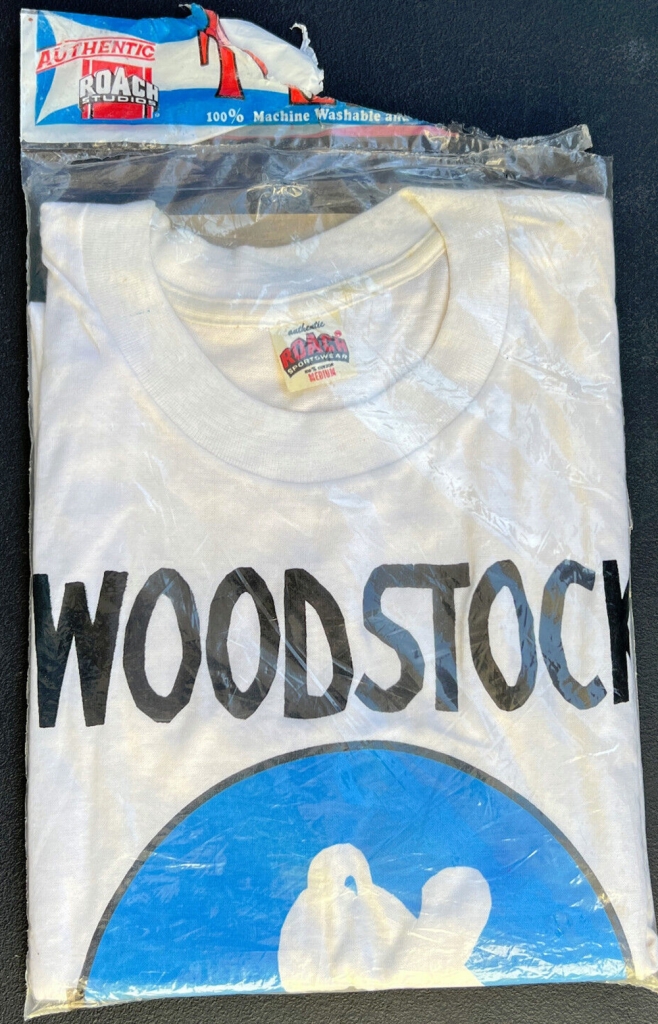
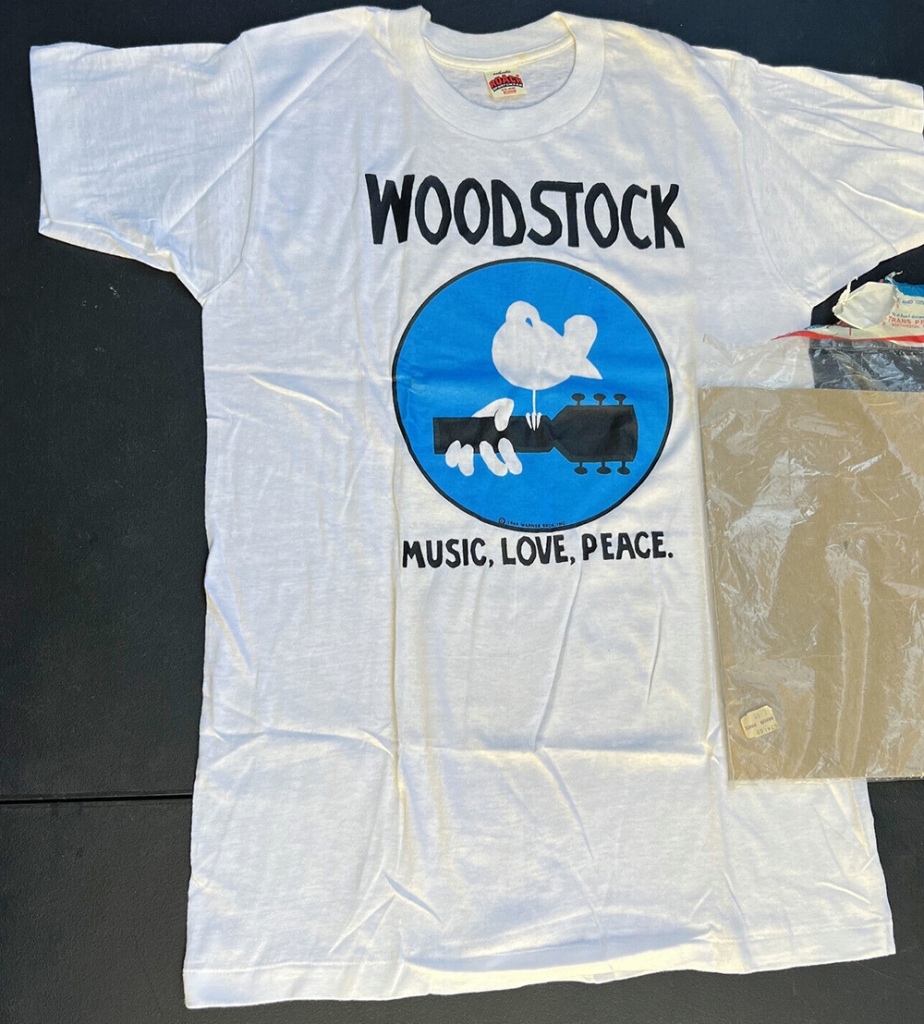
The 1969 copyright confuses matters, but note that they were obviously working on the document in 1969. Plus, and we’ve discussed in a past article, a copyright date doesn’t necessarily represent the date it was printed,
Interestingly, many of these tees often don’t have the Warner Bros. Inc. copyright, yet the design matches.
Here’s an account of a T-shirt purchased circa 1970, with no copyright.
“I was working in a tee shirt store in New Jersey, when I purchased this tee. Employee discount, of course! The boardwalk store was off Eighth Avenue in Asbury Park. I wish I could recall its name, but it wasn’t a memorable one! The shirts were sold as is.” – Misty Denman
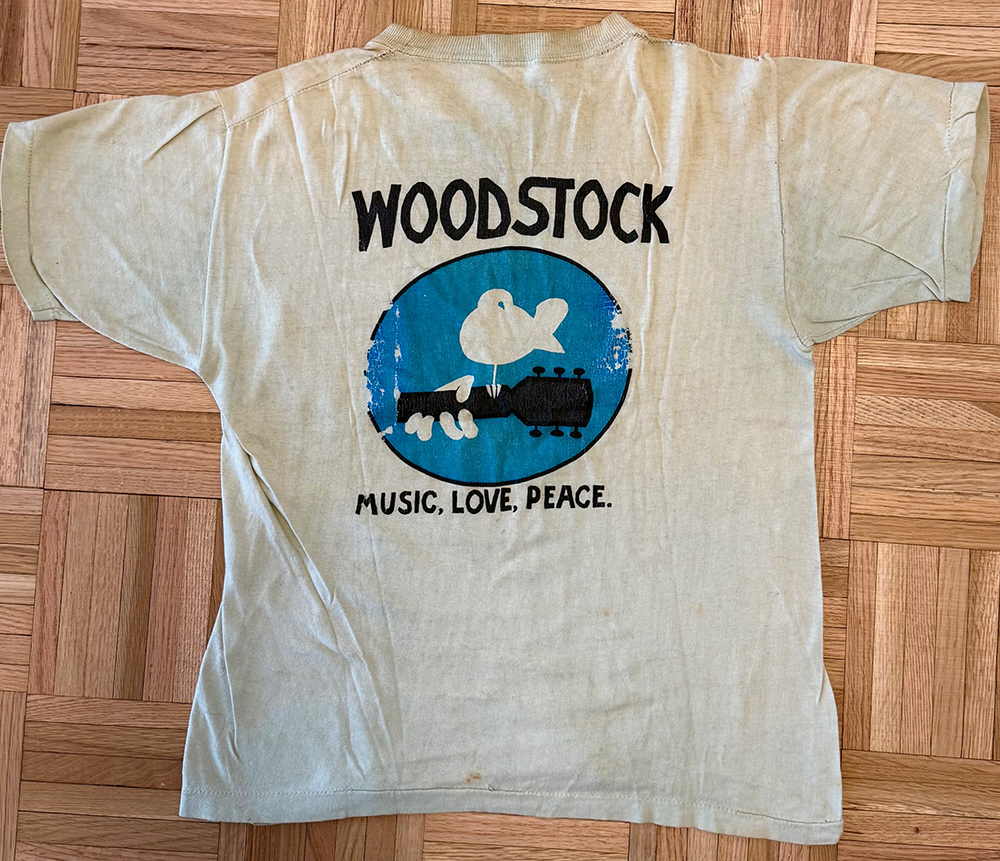
Courtesy Misty Denman
Some T-shirts lack a copyright, and the design isn’t a perfect match, suggesting they could be bootleg versions of these promo t-shirts.
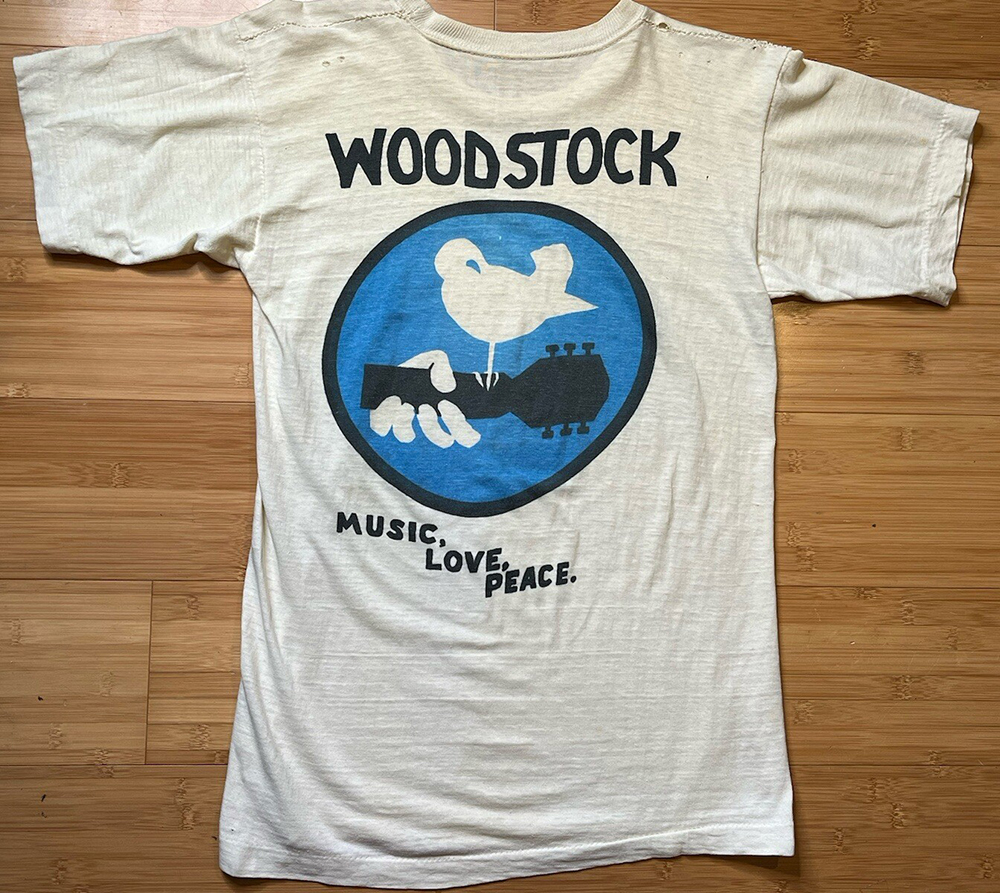
WorthPoint
There’s a variant of this design that features a modified Dove/Guitar and a streamlined logo, yet appears official, complete with Warner copyright.
One theory is that it was released in conjunction with the Woodstock album, a few months after the film. However, the revamped design remains largely a mystery.
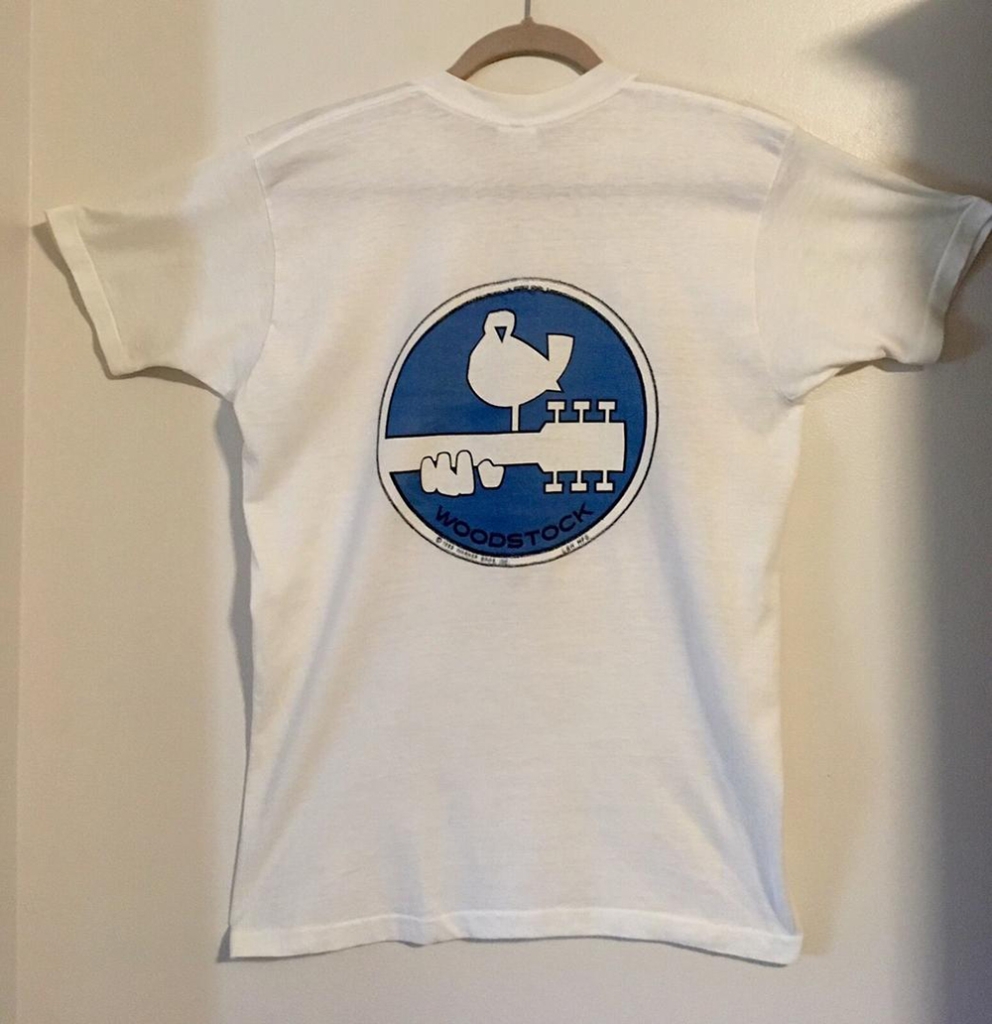
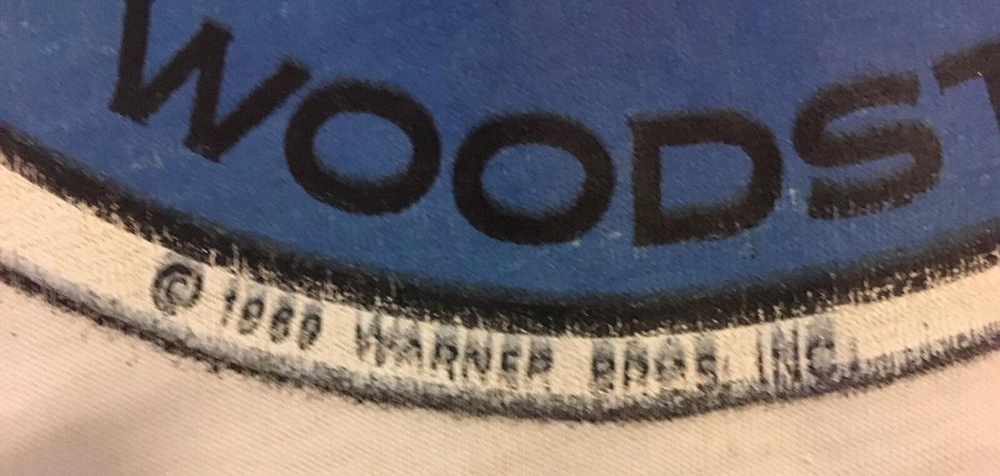
No evidence ties these T-shirts to the 1969 event itself. The ©1969 and ©1970 designs appear to be associated with the documentary and soundtrack promotional campaigns — produced after the festival, not sold to festival-goers at Yasgur’s Farm.
With the festival incurring a substantial financial loss, to the tune of 1.3 million 1969 dollars, the organizers saw t-shirts as one way to recoup losses.
After the partnership fell apart, they sought control of the intellectual property assets.
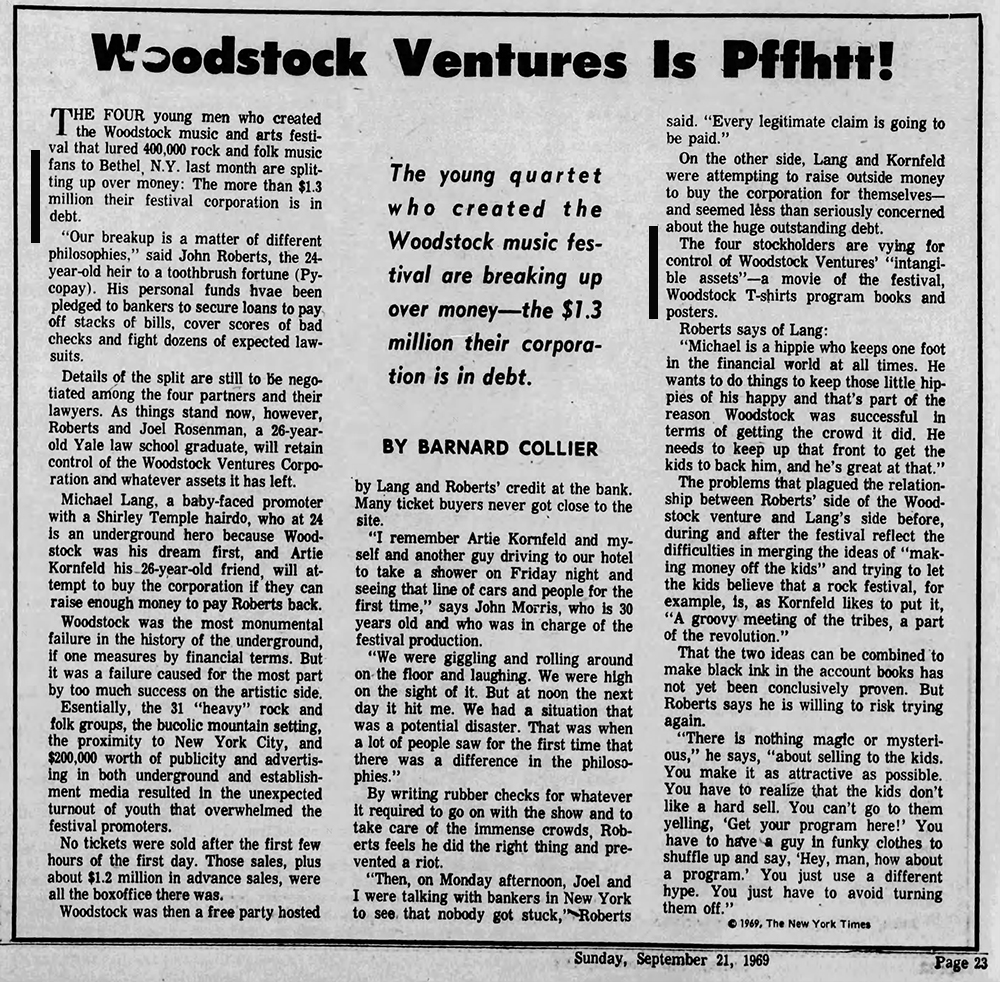
The Houston Chronicle, 1969
The T-Shirts That Followed: The ’70s & ’80s Tribute Wave, Official and Bootlegs
The real explosion of Woodstock T-shirts came after the festival in the form of 1970s, 80s, bootleg, and tribute t-shirts.
By the early 1970s, the Woodstock mythology had already begun to form. Independent printers across the U.S. went to work.
Many of these were entirely unauthorized — cottage-industry Americana created in basements, garages, and small print shops.
For collectors, these shirts hold tremendous charm. They reflect the decade’s DIY ethos and the growing nostalgia for an event that symbolized a cultural turning point.
1979 was clearly an opportunity to cash in on the nostalgia surrounding Woodstock’s 10th anniversary. We spotted these ads in Rolling Stone around that year.
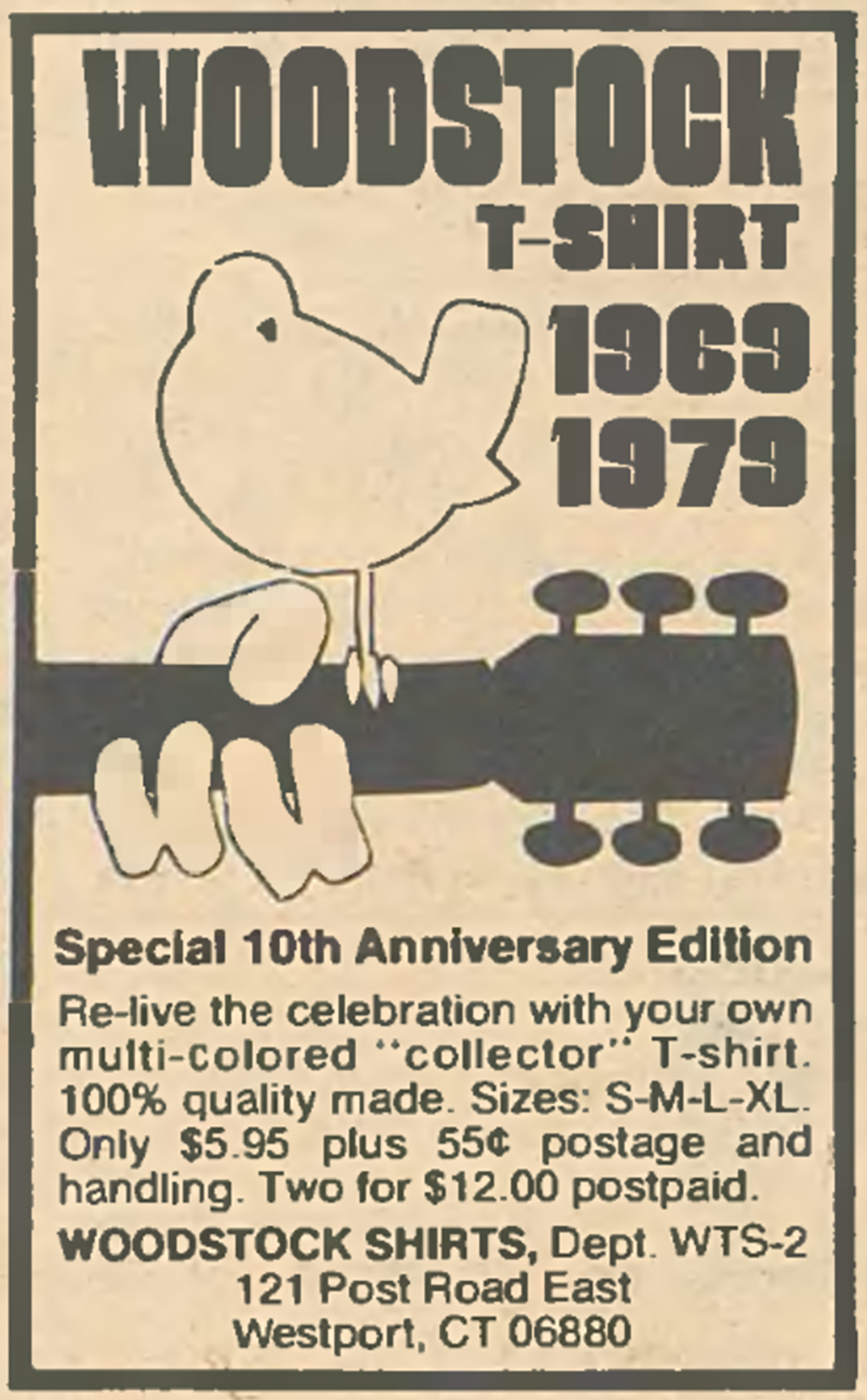
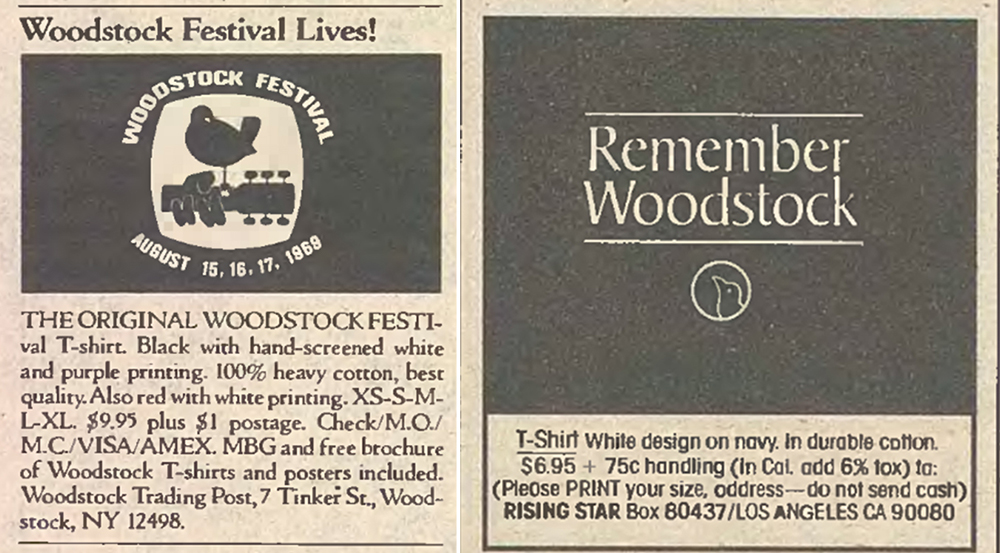
Rolling Stone Magazine Circa 1979
A Contender for a non-staff Woodstock T-Shirt
One of the most intriguing pieces of evidence surrounding the long-debated possibility of non-staff Woodstock shirts comes from a 50th-anniversary newspaper article about a couple, Peter Kiendzior and his wife, Cathy Kennedy Kiendzior, who attended the original 1969 festival. In the piece, Peter recounts his experience at the event along with a photo of his Woodstock T-shirt, which he says he purchased there in 1969.
The t-shirt in question? The one that prominently features a pipe-smoking gentleman on the back of the t-shirt.
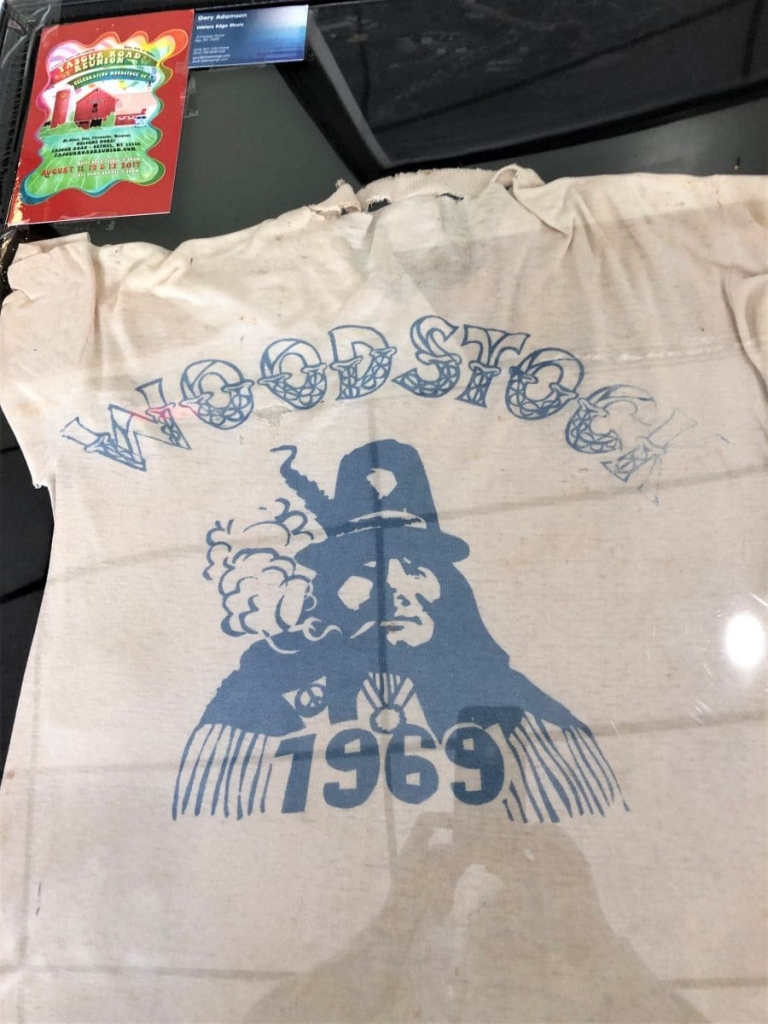
Courtesy: Cathy Kennedy Kiendzior Credit: Amy Porter The Westfield News
We contacted Peter independently for additional clarification regarding the T-shirt shown in the piece.
In his own words: “I bought the T-shirt right near the stage on the last day I was there (Sunday). I did not see any other shirts for sale all weekend. I don’t remember a duffle bag, but it wasn’t an official stand or anything. I stuffed it in my sleeping bag and found it 25 years later.” This account represents the most specific firsthand description we’ve encountered of a non-staff Woodstock shirt being acquired at the 1969 event itself.
Viewed in isolation, the claim is anecdotal.
However, when considered alongside this grainy footage from the Woodstock movie, spotted by eagle-eyed Max Bittle, it appears to show the same t-shirt graphic. This forms the narrowest but most compelling evidence we’ve found so far.
Here are two separate screen grabs from the same sequence showing what appears to be the pipe-smoking figure graphic on the back of a T-shirt. The shape, scale, and placement of the graphic in both frames are consistent, strongly suggesting the same design is visible across multiple moments in the film.
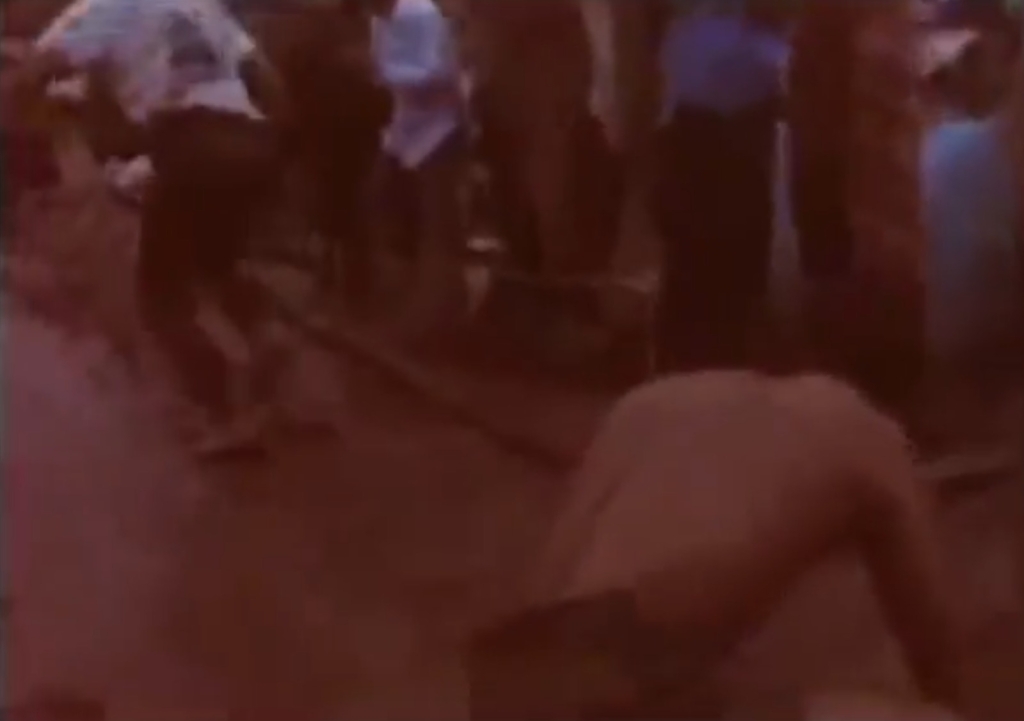
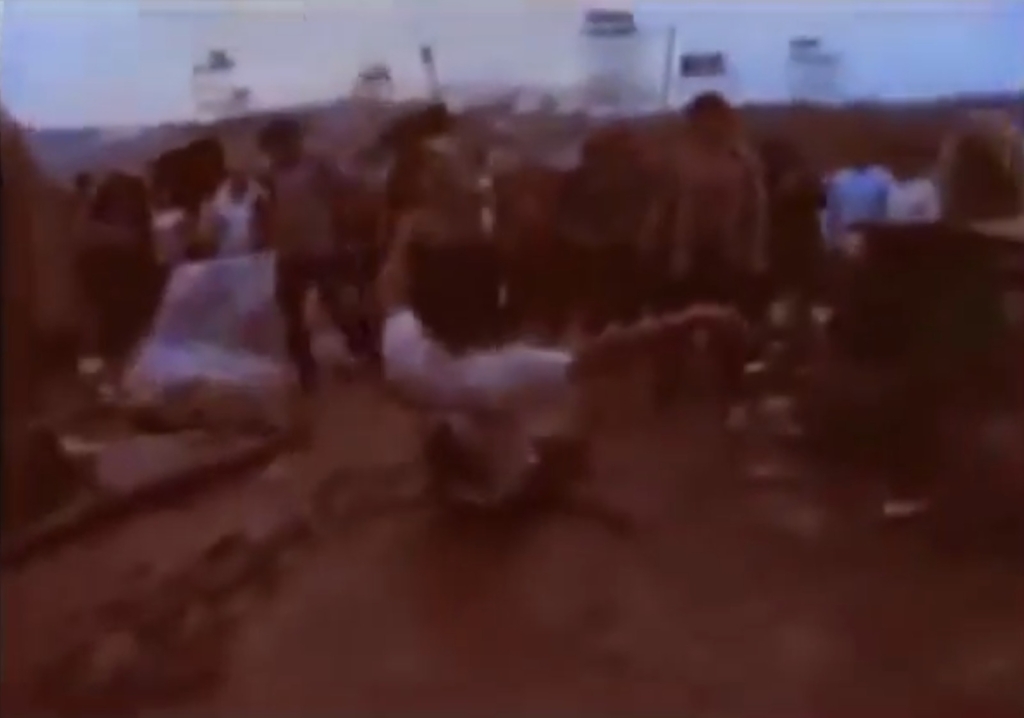
YouTube/biginjapan89
Taken together, these two strands—a firsthand account from an attendee and footage from Woodstock appearing to show the t-shirt in two different shots—constitute the strongest leads currently available, suggesting that at least one non-staff shirt can be documented at the event.
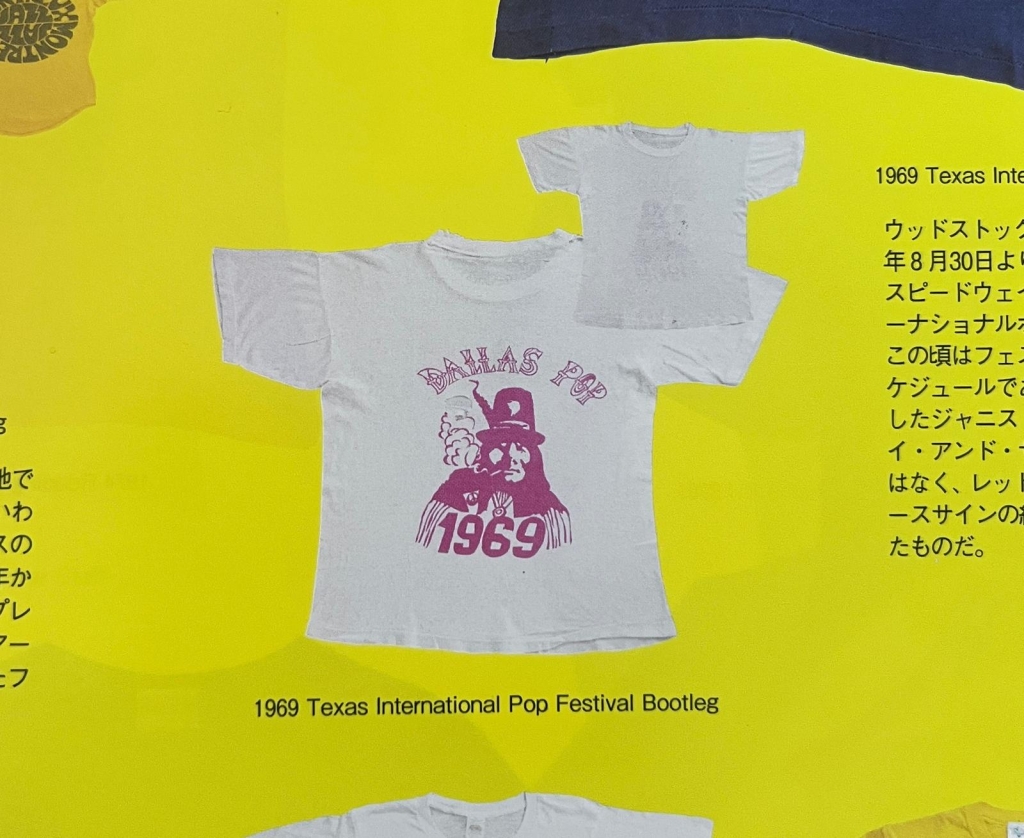
The presence of a second 1969 festival bootleg T-shirt, using the same base print, is a noteworthy data point. The Texas International Pop Festival, which took place just two weeks later and featured its own variation, suggests that the design was likely prepared in advance and that these shirts were intended for festival-era distribution rather than produced entirely after the fact.
The tee was featured in Yasuhiro Takeishi’s 2013 book Listen to this T-Shirt.
Courtesy Max Bittle/Listen to this T-Shirt
Why This Matters: Setting the Record Straight
The Woodstock T-shirt story is more than a collector’s puzzle — it’s a window into how myths form.
Today, a music festival without merch is unthinkable. But in 1969, the priorities were different:
Feed the people.
Keep them safe.
Put on the show.
Hope the stage doesn’t collapse.
Survive the rain.
Avoid mass-electrocution.
The organizers of Woodstock famously lost a small fortune putting on the festival—several millions by today’s standards. What was intended as a ticketed, profit-generating event quickly unraveled into a massive, unplanned free concert when hundreds of thousands of people flooded the site faster than fences, ticket booths, or infrastructure could be built. Costs spiraled: emergency food shipments, medical support, last-minute construction, artist fees, cleanup, and crushing logistical overruns. By the time the weekend ended, Woodstock Ventures was deep in debt, and it took years—plus the eventual success of the documentary—to climb back to even. In hindsight, merchandise could have been a crucial revenue stream. Had they sold official shirts, posters, or souvenirs to half a million attendees, it might have offset some of the financial chaos.
Merch?
That was a future industry.
So the “Woodstock T-shirt” as we know it — the one many people have worn — is a retrospective creation, born of nostalgia, film exposure, and the reverence that followed the event.
Meanwhile, the only true Woodstock tees were worn by hundreds of staff members whose job was to simply keep the whole thing running.
In that sense, the scarcity of authentic Woodstock shirts feels fitting.
The festival was never about selling something.
It was about being there, not buying there.
And maybe that’s the most Woodstock thing of all.
“We’re not perfect. There are some small decisions we would have changed here and there, but for the most part, if we weren’t happy with the way something felt, then we didn’t go ahead … What happened in 1969 and how it feels to us is more important than pretty much any commercial consideration.” – Joel Rosenman
How Much Are Vintage Woodstock Staff T-shirts Worth Today?
It feels slightly at odds with the spirit of Woodstock to even put price tags on these shirts, but the market tells a story of its own. In September 2024, a blue staff T-shirt sold on eBay for $2,500, while another blue example changed hands in mid-2025 for closer to $1,200. Prices clearly fluctuate, and many transactions happen privately.
For reference, the green staff shirt I acquired several years ago was purchased privately for $1,000. Based on those benchmarks, red staff shirts—distinguished by their front-and-back prints—could reasonably command prices in the $3,000+ range. Black t-shirts, produced in the smallest quantities and seemingly reserved for VIPs or senior staff, should logically command the highest price.
And yet, if you ask me, even those figures feel low.
How much are Bootleg Woodstock Tees Worth?
Over the past three years, the highest price we’ve seen for a non-staff Woodstock T-shirt is $900. That example was described as a stagehand shirt and is shown in our gallery above. Although it was green-ink printed on a gray blank, it raises questions about the claim.
Another frequently cited design—the shirt featuring the pipe-smoking man—has sold twice in the same period, once for $500 and again for $750. Given the details we’ve uncovered about this t-shirt, it seems reasonable that it would increase in value amid a sea of other unconfirmed designs.
Beyond those outliers, values drop off sharply, with most non-staff Woodstock shirts trading in the $100–$300 range.
That could change, of course, if one day someone can definitively prove that one of these shirts was actually worn or sold at the 1969 event…
The Uncharted Territories
We’re eager to hear from anyone who was there and may remember shirts being sold or traded—either outside the gates or out of a duffle bag somewhere within the festival grounds. Even more importantly, if you have a photo (or have seen an image or video) of someone at Woodstock wearing a non-staff T-shirt featuring the dove logo or any Woodstock-related design, we’d love to connect.
Except for the mudslide clip noted above, our review of hundreds of photographs and hours of footage has not revealed a single attendee in any other bootleg tee. But with more than 400,000 people in attendance and only a tiny fraction ever photographed, spotting such a shirt today is a genuine needle-in-a-haystack challenge. Even if we never locate another image of one, it doesn’t entirely rule out the possibility of further unofficial t-shirts.
There remain some unexplored territories—the Woodstock photo books published over the past 50 years, many of which contain hundreds of images that have never appeared online, and several documentaries produced after the 1970 film.
As we embark on the lengthy process of acquiring and studying these volumes—our final frontier in this search—your snapshot, memory, or lead could provide the missing link that further confirms additional non-staff Woodstock shirts existed at the 1969 festival.
If you have evidence or firsthand stories to share, recognize any of the T-shirts shown here, or can offer clarification, we invite you to reach out and help us document this still-unresolved chapter of Woodstock history.
Please contact us here.

James, aka Jimmy J, founded Defunkd 21 years ago, and has been buying, selling, collecting and studying vintage t-shirts ever since. He's had a special interest in authenticity since 2010 when he created the blue print for the t-shirt authentication process. For more, check the history of Defunkd and Jimmy's Expertise.