Movies
Ding-Dong: The Wizard of Oz T-Shirt Myths Are Dead

You’ve probably heard the claim by now: MGM handed out “Wizard of Oz” promotional T-shirts at the 1939 premiere. It’s a delightful image: moviegoers in Hollywood walking out of the theater in matching tees, long before the T-shirt conquered the world.
There’s just one problem.
There’s no evidence that it happened.
And the most critical piece of evidence doesn’t exist. No documented surviving example of a 1939 premiere giveaway shirt has surfaced.
“But it was 86 years ago, and there were probably only 500 made!”
Given the cultural impact of Oz, how groundbreaking the film was at the time, how it remains relevant eight decades later, doesn’t this seem odd that a key piece of memorabilia from the premiere is more elusive than the Wizard himself?
The Wizard of Oz received 6 Academy Award nominations, resulting in 2 wins, along with a slew of other nominations across various award bodies. The fact that not a single one of these promo t-shirts was stashed away by a producer, promoter, publicist, cast member, or anyone else who attended the premiere does not bode well for the legitimacy of the claim.
But let’s not rely solely on the physical shirt.
What follows is the historical record—pressbooks, auctions, archives, and premiere coverage—plus where the myth likely began, what the film actually puts on those Emerald City torsos (spoiler: not a screen print), and why the on-screen “OZ” tee still earns a nod in the evolution of the graphic T-shirt.
What the paper trail says (and doesn’t)
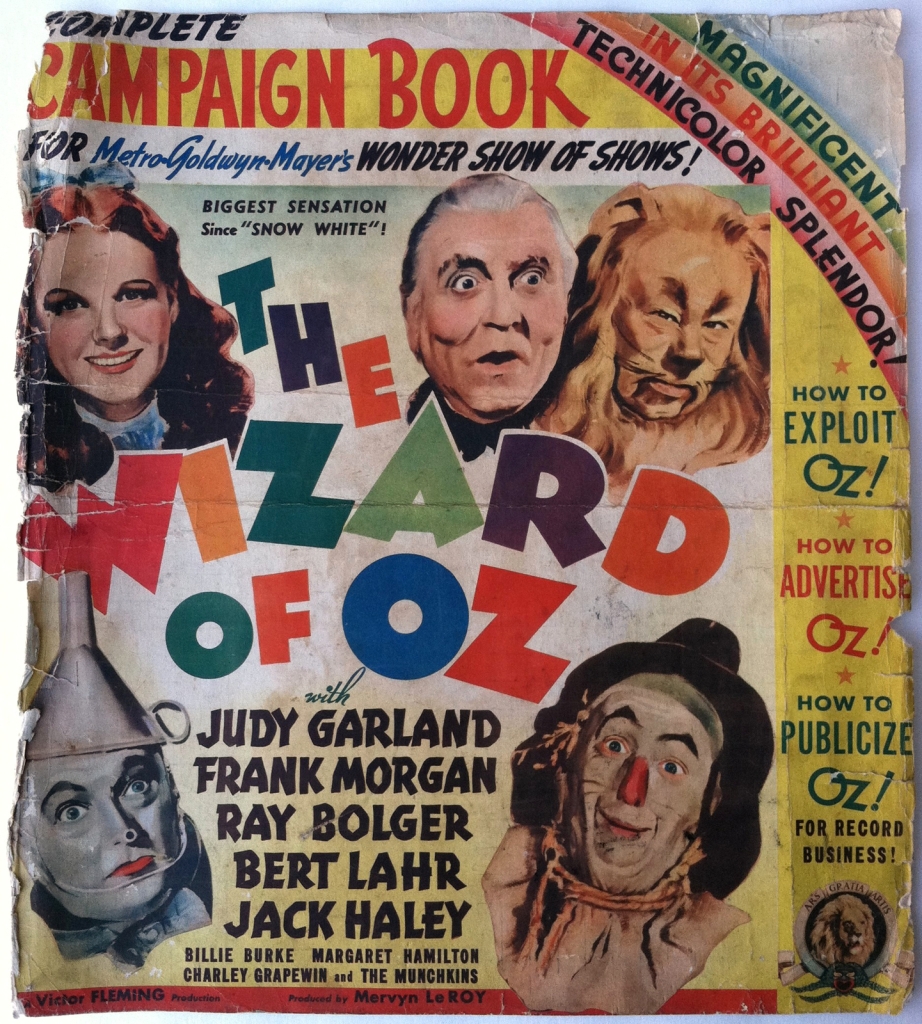
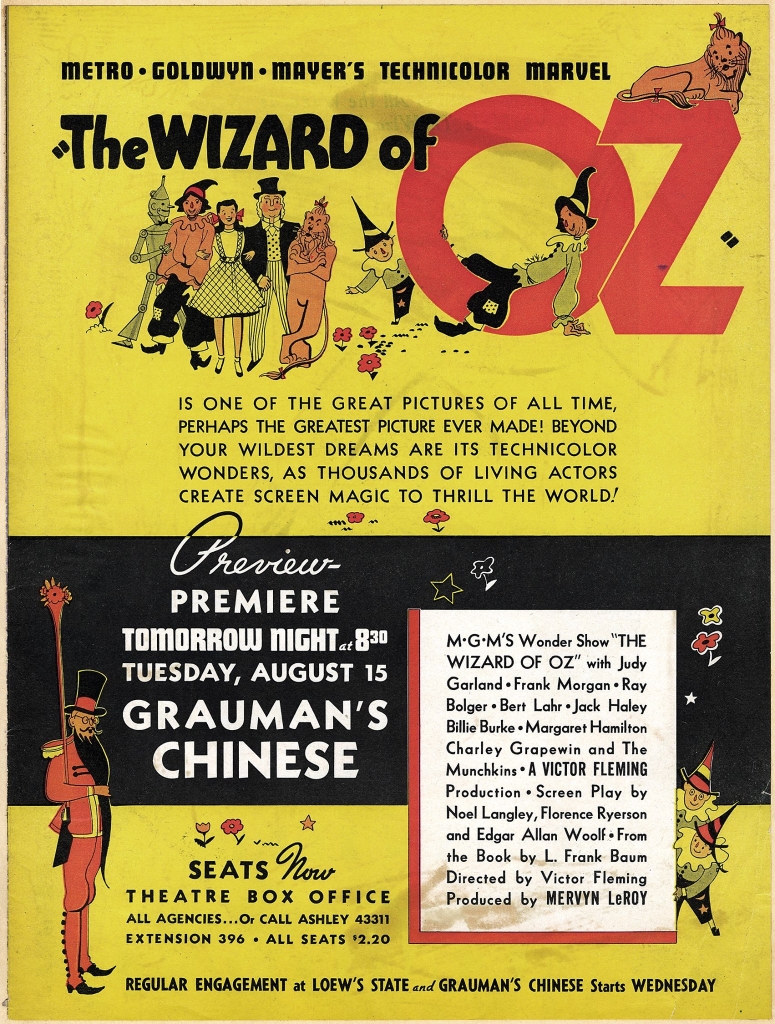
For films of the 1930s, the gold standard for studio marketing evidence is the exhibitor campaign/pressbook—the official kit telling theaters exactly how to promote a title: posters, lobby cards, street ballyhoo, tie-ins, and any giveaways. Surviving Wizard of Oz pressbooks are well-described in auction listings and collector summaries. They enumerate items such as posters (from 1-sheet to 24-sheet), standees, banners, heralds, ad mats, usher buttons, contests, and music tie-ins.
Filmic Light
What they do not include is T-shirts; take a look here.
Independent archival write-ups echo this: Syracuse University’s Special Collections—custodians of relevant Baum/Oz marketing materials—describe posters, leaflets, and MGM promotional matter, but again, no shirts turn up in their overview. If T-shirts had been a marquee element of the 1939 campaign, they would almost certainly appear in such holdings or their descriptive posts. They don’t.
Premiere chronology is well-documented: the Oconomowoc (Wisconsin) unveiling on August 12, 1939, Hollywood’s Grauman’s Chinese on August 15, and New York’s Loew’s Capitol on August 17, with Judy Garland and Mickey Rooney performing live. None of the contemporary retrospectives or local histories that celebrate those dates mentions a T-shirt handout. (Oconomowoc, which loves its bragging rights, certainly would.)
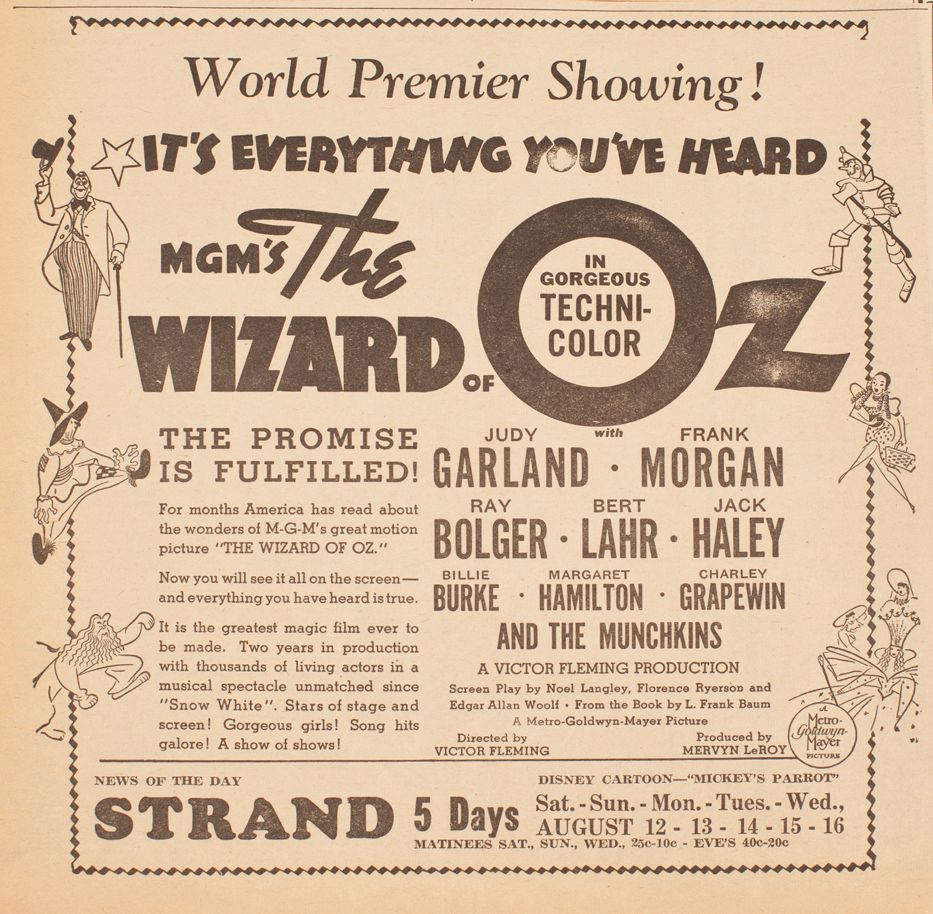
MGM ad in a local Oconomowoc newspaper, courtesy: Moonlit Movies
In other words, the places most likely to record a giveaway—the pressbook and premiere coverage—are silent.
“But I saw an Oz shirt at auction…” (You probably did—and it was wardrobe.)
The Heritage and Bonhams Auctions
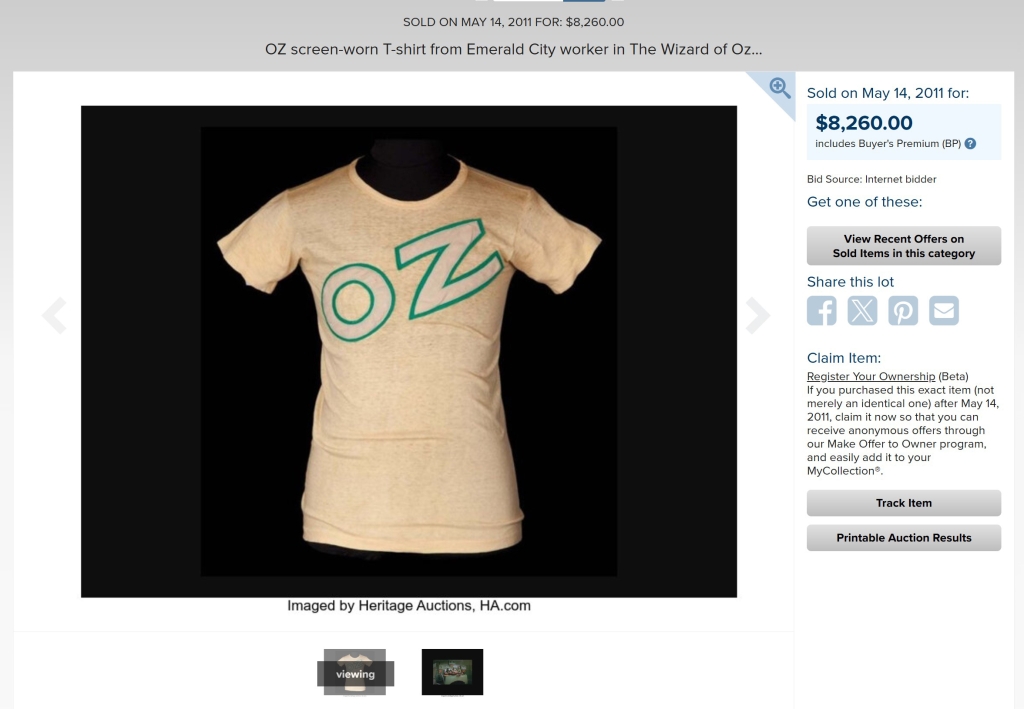
A major breadcrumb in this discussion is the screen-worn Emerald City worker T-shirt sold by Heritage Auctions. The listing is detailed: a vintage 1930s Oneita Underwear cotton T-shirt, modified by the MGM wardrobe department, features “cream felt ‘OZ’ letters” on a green body whose original hue has faded/laundered to a dull yellow. That is a costume, not a promotional handout.
A separate 2014 Bonhams lot—“An Emerald City worker’s ‘OZ’ t-shirt”—was withdrawn before sale. Whatever the reason, a withdrawn listing does not constitute proof of a giveaway (and in fact, Bonhams’ description again reads like wardrobe provenance, not premiere swag).
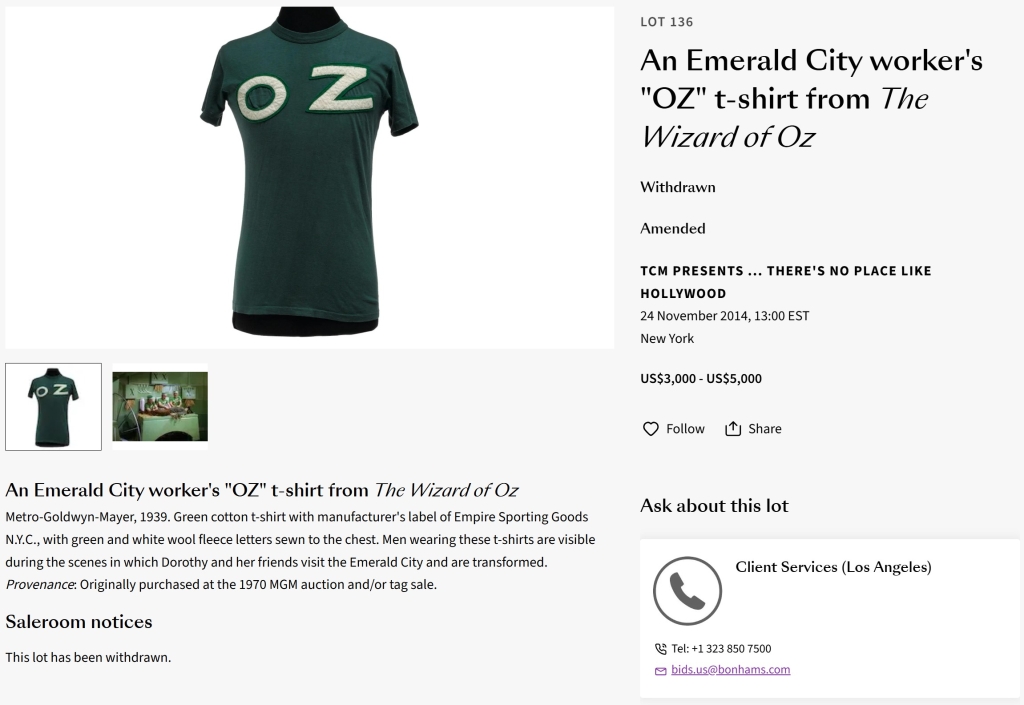
We contacted Bonhams to ask why the listing was pulled, but as of yet, we haven’t received a response. Based solely on the photos in the auction, the design does not match the one that appeared on screen, nor does the rich dark green color. At best, it reads like a wardrobe variant or prototype; either way, it doesn’t match the on-screen style.
“But maybe that one IS the giveaway!”
Well, according to the lore, the giveaway was a simple t-shirt that read “The Wizard of Oz,” and this clearly doesn’t match. Further, Bonhams cites provenance as the “1970 MGM auction and/or tag sale,” the famous studio liquidation through which vast amounts of wardrobe and props entered the collector market. That pipeline is exactly where screen-used items typically originate; it is not where you’d expect a theater giveaway to surface.
Not only that, the technique and construction are wrong for a giveaway. Both Bonhams’ withdrawn t-shirt and the verified Heritage piece are felt appliqué—raised felt letters stitched to the knit—not ink. That is labor-intensive, wardrobe-typical work (sew rooms, one-offs/small runs), not a likely publicity department technique for a large quantity giveaway.
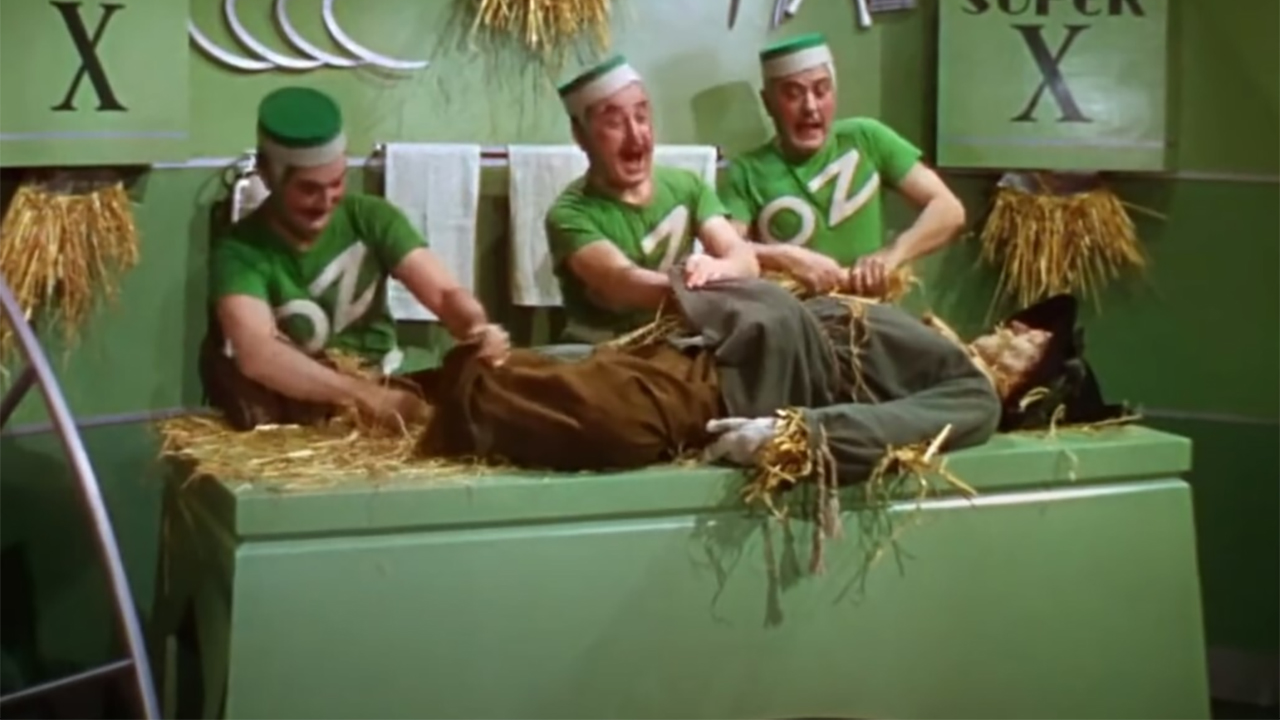
These wardrobe shirts are plainly visible in the film’s Emerald City “makeover” sequence. They’re a great sight gag and a convincing world-building touch—but they’re the costume department’s creation, not the publicity department’s. That distinction matters. (Ask any printer who’s tried to replicate a felt appliqué with ink.)
The expert quote that matters
Promotional-products trade media has looked into the “first promo tee” claim. In a piece on the murky origin story of promotional T-shirts, Oz historian John Fricke (who has worked with MGM/Turner/Warner on Oz history) offered this on the 1939 garment idea:
“I had a list of the original 1939 MGM licensees—about four dozen in all—and the products they proposed to produce. Only a small percentage of the companies followed through, however, and the minimally-considered concept of Oz garments pretty much went by the wayside. Given the historical lack of evidence, it seems they were never realized.”
That is as close as we get to the oft-repeated “there was an idea, but it was scrapped.” It’s not a former studio executive speaking, but it is an authoritative historian referencing original licensee lists—a level of specificity conspicuously absent from the rumor mill.
(We searched for quotes from 1939 MGM publicists or executives confirming T-shirt promotions and found none. If such a quote existed in trade papers or studio memos, we’d expect it to be widely cited by now. It isn’t.)
So where did the myth come from?
A tidy myth needs two ingredients: a vivid image and a plausible leap. Oz provides both.
The vivid image: in the film, Emerald City workers wear tees emblazoned with “OZ.” That’s early and striking—so striking that modern blogs and listicles point to the scene as the first “graphic tee on screen,” sometimes sliding (accidentally or otherwise) from on-screen costume to off-screen giveaway.
The plausible leap: if you believe there were Oz T-shirts in the film, isn’t it logical that MGM also made Oz T-shirts for the audience? Many sites take that step, flatly asserting that “promotional T-shirts were given away at the premiere”—but without pointing to period ads, studio press, or archival proof. The claims are circular: a blog cites another blog cites a promotional print shop’s social post. No primary source appears.
As an example, here’s the claim Cracked made:
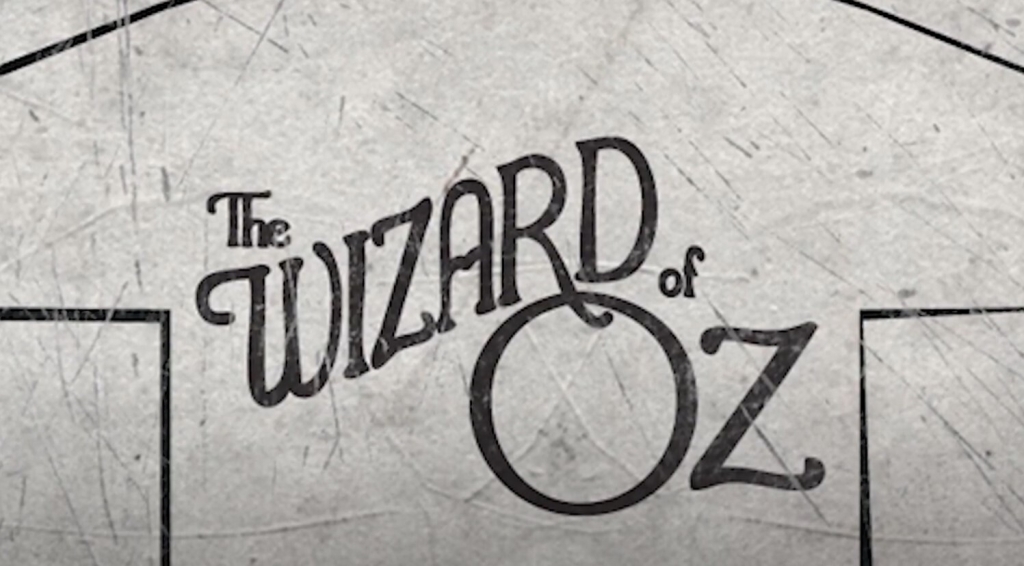
“The movie’s creators clearly saw the screenprinting on the wall, though. The idea of the easy, expressive graphic tee seemed to enamor them, since their contributions to graphic T-shirts didn’t end on screen. As a bonus, The Wizard of Oz also produced the inaugural promotional graphic tee, a simple ‘Wizard of Oz’ T-shirt that was given away at the film’s premiere.”
They supplemented the claim with a “vintage” tee graphic and a link to a screenprinter’s YouTube video titled “Wizard of Oz: the first promo tee EVER.” The video provides no documentation, and that very account likely made the image of the shirt.
What about “former execs” or studio voices?
We looked for statements from 1939 MGM publicity executives or campaign managers that corroborate a T-shirt handout and found none in accessible records. The best available sourced comment is historian John Fricke’s summary that garment concepts were floated but “went by the wayside”—which aligns with what the pressbooks and collections don’t show. If a retired MGM publicity lead ever went on record about shirts, it hasn’t surfaced in trade histories or archives accessible to us today.
What the movie’s “Oz” shirt actually is (and isn’t)
A recurring misunderstanding in print history circles is the claim that the Oz shirt represents the earliest screenprinted T-shirt. It doesn’t. In fact, until I did this deep dive, I admittedly thought it was an ink application too.
Over a decade ago, we published a guide to vintage t-shirt appraisal. I used the OZ t-shirt as an example of a potentially extremely valuable vintage t-shirt.
“If you happen to stumble across an OZ shirt from the 1939 film, The Wizard of Oz, you can start thinking about retirement…” I wrote.
At that time, I didn’t notice the letters were raised due to the poor quality of the photos online at the time. But after reviewing more clips from the movie at a higher resolution, it becomes pretty clear it’s an appliqué, not a screenprint as suggested on social media, and boasted by the screenprint industry.
Nor did I realize that three years before I wrote that post, one had been auctioned and sold for $8,260.00.
My younger self pictured Emerald City green; in truth, the $1 million estimate floated on social is more poppy-field dream than home-again reality.
The Heritage description is unambiguous: felt appliqué, sewn to the shirt by MGM wardrobe. That means raised letters with visible stitching (likely zig-zag/whipstitch), not ink sitting in the knit. It’s a decorated tee, graphic, yes—but not a printed one.
A helpful taxonomy:
Ink-based decoration: screenprint, transfer, litho—flat pigment film, no edge stitching
Flock: velvety surface, adhesive-bonded fibers—no stitching
Appliqué (Oz): felt letters stitched down, visibly thicker—stitching shows inside and out
So why is the surviving example of the screen-worn t-shirt discolored?
A 1930s green cotton can fade toward yellow when the blue component of the dye washes out faster than the yellow (common with period dye chemistry, hot washes, and bleach), and the cotton substrate itself tends to yellow with oxidation. The Heritage lot even notes the fade.
So why is the kelly green part of the appliqué still so rich in color?
The shirt fabric and the “OZ” letters aren’t the same stuff—and they don’t fade the same way. The appliqué staying vibrant while the shirt goes yellow isn’t a contradiction—it’s exactly what you’d expect when wool felt (acid-dyed) sits on top of cotton (direct-dyed) for 80+ years of light, soap, and air.
Provenance first: it’s tied to MGM wardrobe. So even if you doubt it’s the on-camera piece, it still demonstrates that the “OZ” was stitched felt, not ink on cotton.
Giving Oz its due (without the myth)
Let’s give credit where it’s due: The Wizard of Oz does give us an early, clear cinematic appearance of a graphic on a T-shirt—even if that graphic is sewn, and not ink. In a medium that, in 1939, still treated T-shirts as underwear, showing workers in matching tees with bold letters was a quietly modern touch. It’s easy to see how that on-screen moment later fed into the idea that Oz also spawned the promotional tee.
But until someone turns up a 1939 ad promising “Free Oz T-shirts Tonight!”, or a pressbook page offering theaters “Official Oz Shirts,” or a period photograph of premiere crowds wearing them, or how about one of the actual t-shirts?
Until then, the giveaway remains a lovely story—and overwhelmingly likely to be lore.
Yo, Adrian!
Costume credit matters here, too. Adrian (Adrian Adolph Greenberg)—MGM’s house visionary who later dressed Oz characters—was the costume designer on Broadway Melody of 1936 (released in 1935), where dancer Buddy Ebsen turns up in a long-sleeve top bearing Mickey Mouse on the chest.
In frame grabs and stills, the Mickey motif reads like another felt appliqué—thick, raised, and likely stitched down—prefiguring the Emerald City “OZ” tees’ construction and underscoring Adrian’s willingness to put bold, graphic imagery on knitwear years before printed tees went mainstream. Historically, that’s notable on two fronts: it’s an early instance of a character graphic on apparel in a major studio film, and it hints at the cross-studio comfort with licensed iconography on costumes well before wartime printed T-shirts took off.
Did Adrian create the graphic shirt or spotlight it? The historians can wrestle with that. If he didn’t invent it, he certainly made it a star. His influence is beyond dispute.
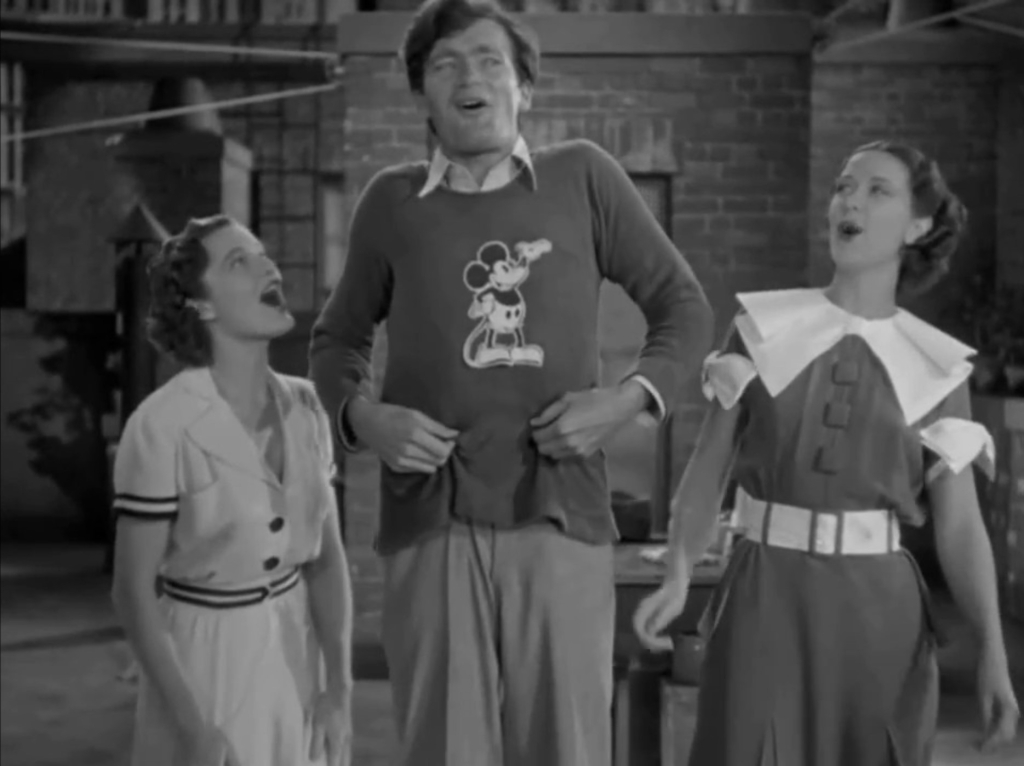
Frame from Broadway Melody of 1936, (1935) © MGM; used here for commentary (fair use).
Conclusion (with a wink)
The Emerald City did many marvelous things. Handing out screenprinted tees to 1939 moviegoers was almost certainly not one of them.
What we can celebrate is that Oz put a bold “OZ” on a T-shirt—via felt appliqué—and beamed it into popular culture years before printed tees hit magazine covers and political campaigns. In an era when the T-shirt was still an undergarment, that’s quietly radical… and, frankly, pretty stylish. Somewhere, a screenprinter is sighing—it’s felt, not ink!—but the larger arc of the graphic tee still bends, just a bit, toward Emerald City.
If a new primary document turns up—a 1939 MGM publicity memo about garment giveaways, a newspaper ad promising a giveaway, or a museum piece with 1939 provenance—we’ll happily investigate and revise the record.
Until then, there’s no place like evidence, and it points away from a premiere T-shirt giveaway.
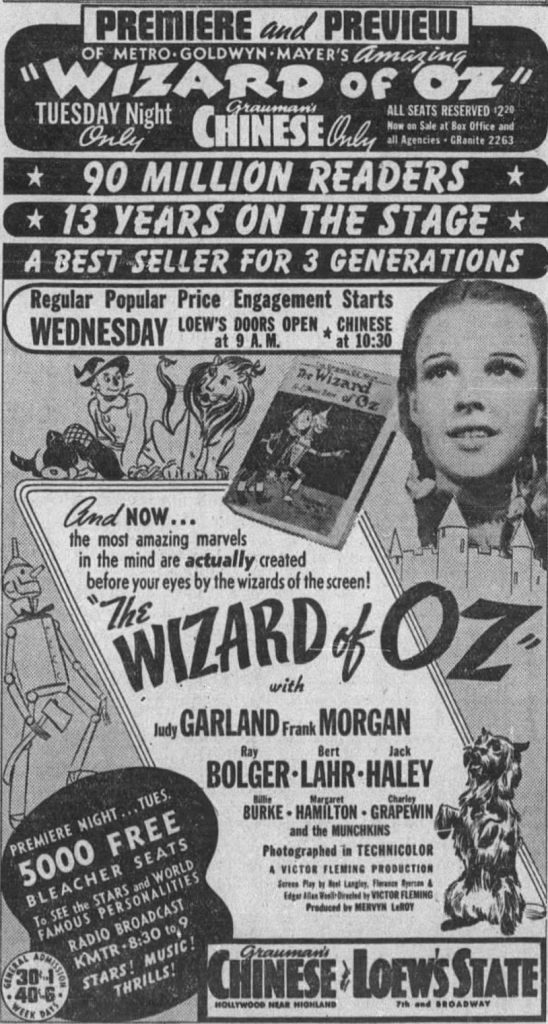
Los Angeles Times August 14, 1939
eBay

James, aka Jimmy J, founded Defunkd 21 years ago, and has been buying, selling, collecting and studying vintage t-shirts ever since. He's had a special interest in authenticity since 2010 when he created the blue print for the t-shirt authentication process. For more, check the history of Defunkd and Jimmy's Expertise.